
If you've ever walked into a workshop, café kitchen, or retail space and thought "wow,…
Epoxy Flooring vs Concrete Paint: Which Lasts Longer? 2026
A few years back, a bloke from Buderim called us after spending $400 on a tin of concrete paint from the hardware store. He’d spent his whole weekend rolling it on, let it cure, and two months later it was peeling off in chunks. His garage looked worse than before he started. Sound familiar?
That story isn’t unique — we hear it all the time on the Sunshine Coast. The question of epoxy flooring vs concrete paint comes up constantly, and honestly, the difference between the two isn’t just about price. It’s about what actually survives our coastal humidity, salty air, and scorching Queensland summers without turning your garage floor into a flaking disaster zone.
The Science Behind Epoxy Adhesion vs Paint Application
Here’s where the two products go in completely different directions — and understanding this makes everything else click into place.
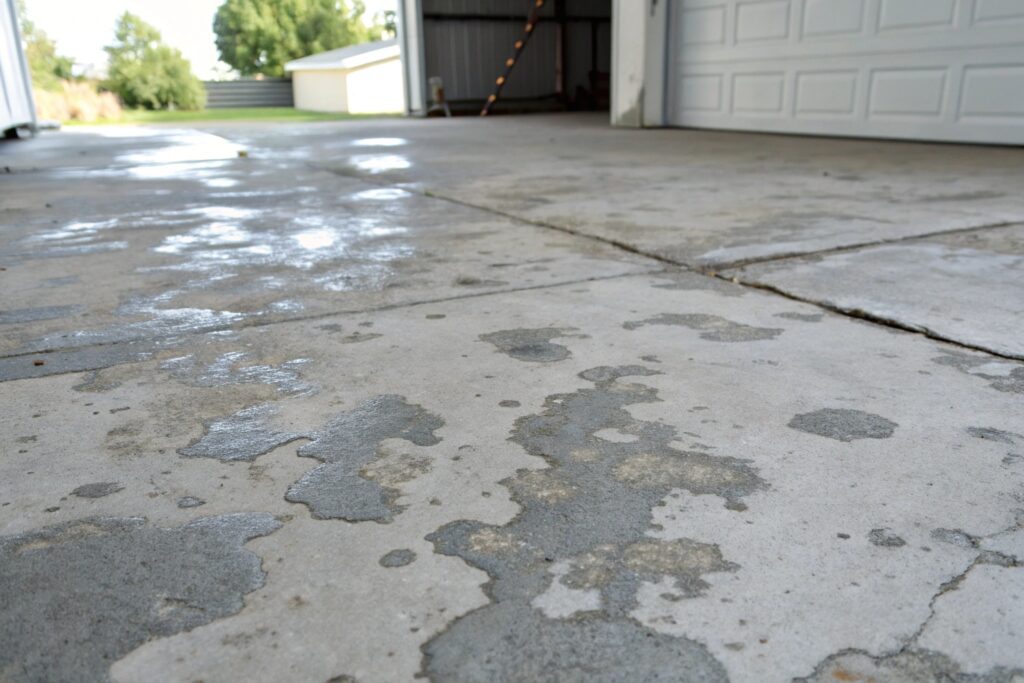
Concrete paint is basically just that — paint. It sits on top of the concrete surface like a skin. It doesn’t bond chemically with the slab, so over time, moisture pushing up from underneath (and trust me, Queensland slabs sweat constantly in summer) has nowhere to go. That pressure builds up behind the paint layer and eventually forces it off. That peeling and bubbling you see? That’s not a bad application job. That’s physics.
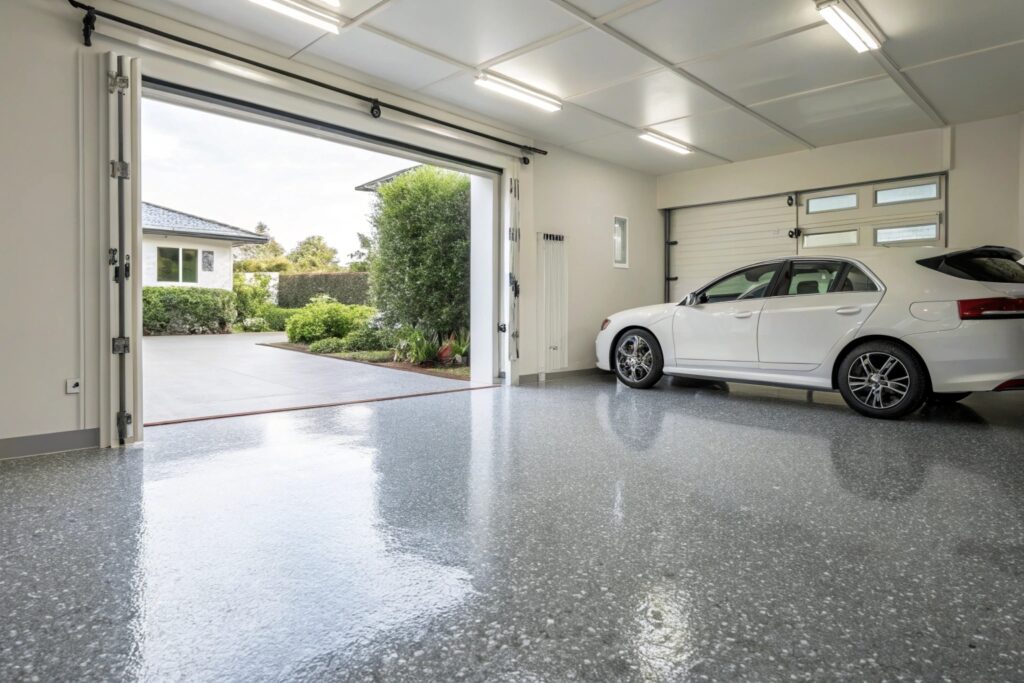
Epoxy flooring works differently at a molecular level. When properly mixed and applied to a prepared surface, the epoxy resin actually penetrates the concrete and forms a chemical bond with the slab itself. It doesn’t just sit on top — it becomes part of the surface. That’s why a quality epoxy installation can handle the kind of moisture, heat cycling, and heavy foot traffic that would destroy a painted floor inside a season.
There’s also a thickness difference worth knowing about:
- Concrete paint: Typically 0.1–0.2mm dry film thickness
- Single-coat epoxy: Around 0.3–0.5mm
- Full flake epoxy system: 2–4mm with basecoat, flake broadcast, and topcoat layers
That extra thickness isn’t just for looks. It’s what gives epoxy its resistance to chips, abrasions, and chemical spills — the kind of thing that’s unavoidable in any working garage.
Cost Comparison: Initial Investment vs Long-term Value
This is where most people get tripped up. They see the price difference upfront and reach for the paint. Totally understandable — but let’s look at what that decision actually costs over time.
Concrete Paint (DIY or basic application)
- Product cost: $80–$400 depending on quality and area size
- Application: Usually DIY, one weekend
- Lifespan on a Sunshine Coast garage: 12–24 months before visible deterioration
- Reapplication needed: Every 1–2 years
Flake Epoxy Flooring (Professional installation)
- Installed cost: $3,000–$6,000 for a standard double garage
- Lifespan: 10–20 years with basic maintenance
- Reapplication needed: Rarely, if ever
Here’s the 5-year cost reality most people don’t sit down and work out:
| Concrete Paint | Epoxy Flooring | |
| Year 1 | $300 | $4,500 |
| Year 2 | $300 | $0 |
| Year 3 | $300 | $0 |
| Year 4 | $300 | $0 |
| Year 5 | $300 | $0 |
| 5-Year Total | $1,500+ | $4,500 |
And that table doesn’t account for the labour time, the prep work each repaint requires, or the cost of having a garage floor that looks rough when you’re trying to sell your home. On the Sunshine Coast property market, presentation matters.
The gap between the two options closes faster than most people expect — especially once you factor in that epoxy keeps performing well past year five without needing a cent spent on it.
Performance Under Queensland Conditions: Side-by-Side Testing
The Sunshine Coast isn’t kind to floor coatings. You’ve got humidity that sits above 80% for months at a time, salt air pushing in from the coast, UV exposure that would bleach the colour out of anything not properly protected, and summer temperatures that make concrete slabs expand and contract on a daily cycle. That’s a brutal combination for any surface coating.
Here’s how the two options hold up against the conditions that actually matter here:
| Condition | Concrete Paint | Flake Epoxy |
| Coastal salt air | Degrades within months | Highly resistant |
| High humidity | Promotes peeling and bubbling | Moisture-tolerant when properly installed |
| UV exposure | Fades and chalks quickly | UV-stable topcoats available |
| Thermal expansion | Cracks and separates | Flexes without delaminating |
| Oil and chemical spills | Stains permanently | Wipes clean easily |
| Heavy vehicle traffic | Wears through rapidly | Handles daily use without issue |
The salt air issue is one that catches a lot of Sunshine Coast homeowners off guard. Properties in Noosa, Mooloolaba, and Caloundra are sitting close enough to the water that salt particles in the air actively break down coatings that aren’t rated for coastal environments. Concrete paint simply wasn’t formulated with that in mind.
Epoxy systems with a quality polyurethane topcoat are a different story. That topcoat acts as a sacrificial layer — it takes the punishment from UV and salt air while the epoxy bond underneath stays intact. It’s the reason you’ll see epoxy floors on boats, in commercial kitchens, and in industrial facilities where conditions are even tougher than your average Sunshine Coast garage.
Installation Process Differences and Why They Matter
The way each product gets applied tells you a lot about how long it’s going to last. And this is where the gap between concrete paint and epoxy flooring becomes really obvious.
Concrete Paint Installation
- Clean the surface
- Apply with roller, usually two coats
- Wait for drying time between coats
- Done in a day or two
Sounds simple, and it is. The problem is that simplicity is also its weakness. Without any mechanical preparation of the concrete surface, you’re applying a coating on top of whatever is already there — old sealer, surface contamination, laitance (that dusty weak layer on the top of cured concrete). Paint can’t penetrate through any of that, which is exactly why adhesion fails so quickly.
Flake Epoxy Installation
- Diamond grinding or shot blasting to open up the concrete profile
- Crack and joint repairs if needed
- Primer coat application
- Base epoxy coat
- Vinyl flake broadcast while coat is still wet
- Seal coat to lock flakes in place
- Polyurethane topcoat for durability and UV protection
That’s a multi-day process, and every single step matters. The diamond grinding alone makes an enormous difference — it creates a surface profile that gives the epoxy something real to grip onto at a mechanical level, on top of the chemical bond that forms during curing.
A professional installer on the Sunshine Coast will also test for moisture vapour transmission before starting. If a slab is pushing too much moisture, there are primers specifically designed to handle that. Skip that step and even a quality epoxy system can fail. It’s one of the biggest reasons DIY epoxy kits from the hardware store underperform — the prep just doesn’t happen the way it needs to.
Real Customer Stories: Paint Failures vs Epoxy Success
The story at the start of this article isn’t a one-off. Across Buderim, Maroochydore, and Caloundra, we see the same pattern play out regularly — and the contrast between paint jobs and epoxy installations tells the real story better than any spec sheet.
The Paint Story
A family in Nambour decided to freshen up their double garage before putting their home on the market. They picked up a quality concrete paint from the hardware store, followed the instructions carefully, and were genuinely happy with how it looked on day one. Six weeks later, during a humid stretch in February, bubbling started appearing near the garage door where afternoon sun hits hardest. By the time their open homes were running, the floor looked worse than it did before they painted it. Their real estate agent actually suggested they either redo it or remove the coating entirely before inspections.
The Epoxy Story
A couple in Noosa had a similar motivation — they wanted their garage looking sharp before listing. They went with a full flake epoxy system instead. The installation took two days, they were off the floor for 72 hours, and three years later that floor still looks the way it did on installation day. When they eventually sold, multiple buyers specifically commented on the garage during inspections. Their agent told them it added perceived value that showed up in offers.
The Workshop Owner in Caloundra
A mechanic running a small workshop near Caloundra had gone through three paint applications in four years before switching to epoxy. The oil spills alone were destroying each coat within months. Since the epoxy installation, cleaning is a five-minute job with a mop and the floor hasn’t needed any attention beyond that.
These aren’t unusual outcomes. They’re what happens when the right product meets the right conditions — or the wrong one does.
When Concrete Paint Might Actually Be the Right Choice
In the spirit of being straight with you — concrete paint does have its place. It’s not always the wrong answer. It depends entirely on what you’re working with and what you actually need from the space.
Situations where paint makes sense:
- Short-term rental properties where you need a quick cosmetic fix before a lease and aren’t planning to hold the property long-term
- Low-traffic storage areas like garden sheds or rarely-used secondary garages that don’t cop vehicle traffic or humidity exposure
- Tight budgets with a defined timeline — if you’re planning a renovation in 18 months anyway and just need the floor presentable in the meantime, paint buys you time
- Covered patios with minimal moisture exposure where conditions are genuinely mild and foot traffic is light
The honest truth is that concrete paint performs reasonably well when conditions are forgiving. The problem on the Sunshine Coast is that conditions are rarely forgiving. The humidity, the salt air, the UV, and the thermal cycling all stack up against a product that was never engineered to handle them long-term.
If you’re in a Sunshine Coast home you plan to stay in, a garage you use regularly, or a property you want to present well for sale — paint is going to cost you more frustration than it saves you money. But if your situation genuinely fits one of the scenarios above, it’s worth knowing that paint isn’t always the wrong call. Just go in with realistic expectations about how long it’ll hold up before needing attention again.

Making the Smart Investment: 5-Year Cost Analysis
By now the picture is pretty clear, but let’s bring it all together in a way that makes the decision straightforward.
Over five years, a Sunshine Coast homeowner who chooses concrete paint will likely spend $1,500 or more — and that’s a conservative estimate that doesn’t account for the time spent reapplying, the frustration of a floor that never quite looks right, or the impact on property presentation when it matters most.
A quality flake epoxy installation sits around $3,000–$6,000 upfront. Spread across ten to fifteen years of use with zero reapplication costs, that works out to somewhere between $200–$500 per year. Less than the paint option, with dramatically better results and zero ongoing maintenance headaches.
The five-year summary:
| Factor | Concrete Paint | Flake Epoxy |
| Total spend | $1,500+ | $4,500 (one-off) |
| Applications needed | 3–5 | 1 |
| Time investment | Multiple weekends | 2–3 days (professional) |
| Presentation quality | Deteriorates quickly | Stays sharp for years |
| Property value impact | Neutral to negative | Positive |
The numbers make the case on their own. But beyond the dollars, there’s something to be said for having a floor you never have to think about again — one that handles whatever Queensland throws at it and still looks the way it did on day one.
Ready to Stop Replacing and Start Enjoying Your Garage Floor?
If you’re on the Sunshine Coast and tired of concrete paint that doesn’t last, our team installs professional flake epoxy flooring systems built specifically for coastal Queensland conditions. Get in touch today for a free quote and find out what your garage could look like — and stay looking like — for years to come.

