
If you've ever walked into a workshop, café kitchen, or retail space and thought "wow,…
Epoxy Flooring Coastal Conditions Queensland: Can It Really Handle the Salt Air and Humidity?
Ask any Sunshine Coast homeowner who’s watched a freshly painted garage floor bubble and peel after just one wet season, and they’ll tell you the same thing — not all flooring holds up the way the brochure promises. Queensland’s coastal climate is relentless. The salt air off the ocean, the humidity that makes your walls sweat, the UV that fades and cracks just about everything — it’s a different beast compared to inland conditions.
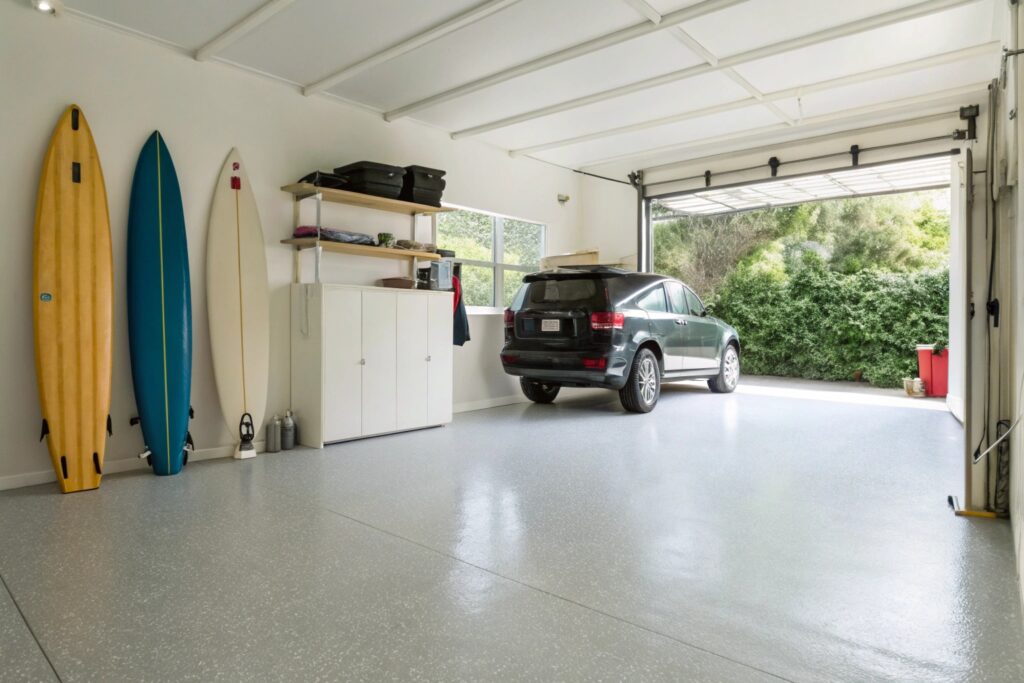
So when flake epoxy flooring started popping up in garages from Noosa to Caloundra, the obvious question was whether it could actually handle it. The short answer? Yes — but only when it’s the right system, installed the right way. Here’s what every coastal Queensland homeowner needs to know before they commit.
Understanding Queensland’s Unique Coastal Climate Challenges
Living near the coast in Queensland is the dream — until your home starts showing the wear. The Sunshine Coast sits in a subtropical climate zone where summer humidity regularly pushes past 80%, salt-laden winds blow in off the Pacific, and the sun doesn’t just shine, it hammers down with UV intensity that ranks among the highest in the world.
What makes this environment so tough on flooring specifically comes down to three factors working together at the same time:
- High humidity causes moisture to push up through concrete slabs, a process called hydrostatic pressure
- Salt air carries microscopic chloride particles that settle on surfaces and accelerate corrosion and material breakdown
- UV radiation degrades surface coatings from above while the moisture works from below
Concrete on its own is actually porous. It breathes. And in a coastal Queensland environment, that means it’s constantly absorbing and releasing moisture depending on the temperature and humidity outside. Standard garage paint sits on top of that surface without bonding deeply — so when moisture pushes up from underneath, the paint lifts. You get bubbling, peeling, and flaking within a season or two.
Suburbs like Maroochydore, Mooloolaba, and Noosa Heads sit close enough to the ocean that salt air exposure is genuinely elevated compared to even 20 kilometres inland. For homeowners in these areas, flooring choices aren’t just about aesthetics — they’re about picking something that won’t need replacing every few years.
The good news is that properly installed flake epoxy systems are engineered to deal with exactly these conditions. But the word “properly” is doing a lot of work in that sentence, which is why the next few sections matter.
How Salt Air Destroys Traditional Flooring (But Not Epoxy)
Salt air doesn’t just make your car rust faster. It works on flooring the same way — slowly, invisibly, and then all at once.
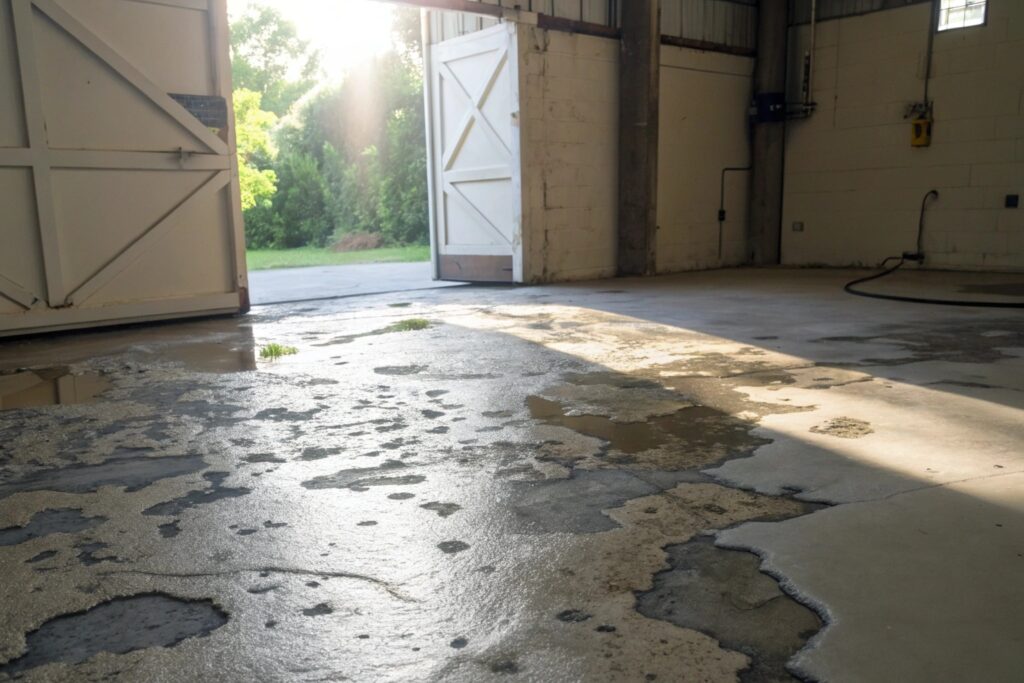
When salt particles land on a standard painted or coated concrete floor, they start drawing moisture into the surface. This process, called hygroscopic absorption, means the coating is constantly wet at a microscopic level even when it looks dry to the eye. Over time, that trapped moisture breaks down the bond between the coating and the concrete beneath it. The result is the classic coastal failure pattern — edges lifting first, then bubbling across the middle, then the whole thing peeling away in sheets.
Traditional floor paints and basic single-coat epoxies fail in coastal environments for a few specific reasons:
- Thin film thickness — standard paints sit at 2-4 mils dry film thickness, which isn’t enough of a barrier against salt-driven moisture
- Poor adhesion chemistry — basic coatings don’t chemically bond to concrete the way multi-layer epoxy systems do
- No topcoat protection — without a UV-stable polyaspartic or polyurethane topcoat, the surface layer degrades and becomes porous, letting salt in even faster
A quality flake epoxy system works differently. It starts with a base coat that penetrates and bonds directly into the concrete profile — which is why proper surface preparation, including diamond grinding, is non-negotiable before installation. That mechanical bond means moisture pushing up from below has far more resistance to overcome before it can cause damage.
The flake layer itself adds both grip and a functional middle barrier. Then a high-build topcoat seals everything from above. The whole system acts as a unified shell rather than a surface coating sitting loosely on top of the slab.
For beachfront and near-coastal homes on the Sunshine Coast, a three-layer flake epoxy system with a polyaspartic topcoat is generally what holds up long-term. It’s not the cheapest option on the quote — but it’s the one that doesn’t need redoing in two years.
UV Protection: Why Standard Epoxy Fails in Queensland Sun
Queensland gets more UV radiation than most places on the planet. The Bureau of Meteorology regularly records UV index readings of 11 and above on the Sunshine Coast during summer — that’s in the “extreme” category, and it’s not just bad for skin. It breaks down surface coatings faster than almost any other environmental factor.
Standard epoxy on its own is not UV stable. Left exposed to direct Queensland sun, it yellows, chalks, and becomes brittle within months. What starts as a clean, glossy floor turns amber, then dull, then starts cracking at the surface. It’s one of the most common complaints from homeowners who went with a cheaper system and didn’t ask the right questions before installation.
The science behind it comes down to the chemistry of standard epoxy resins. They contain aromatic compounds that react when hit with UV light — the bonds break down, the surface oxidises, and the colour shifts. No amount of cleaning fixes it once the UV damage sets in.
Here’s how different topcoat options stack up against Queensland’s UV conditions:
| Topcoat Type | UV Stability | Typical Lifespan (Coastal QLD) | Gloss Retention |
| Standard Epoxy | Poor | 1-2 years | Low |
| Aliphatic Polyurethane | Good | 4-6 years | Medium |
| Polyaspartic | Excellent | 8-15+ years | High |
Polyaspartic topcoats have become the go-to solution for coastal Queensland installs for good reason. They’re built from aliphatic chemistry, which means the molecular structure doesn’t react the same way under UV exposure. The colour stays true, the gloss holds, and the surface stays sealed against moisture and salt air at the same time.
For garages with roller doors that stay open during the day — which is most Sunshine Coast homes in summer — the floor near the entrance gets direct sun exposure for hours at a stretch. That section takes the hardest UV hit, and it’s usually the first place a cheaper system shows its age.
Specifying a polyaspartic topcoat isn’t just an upsell. For a coastal Queensland home, it’s the difference between a floor that looks good for a decade and one that needs replacing before your next repaint.
Moisture Management in High-Humidity Coastal Environments
Humidity is the silent killer of garage floors on the Sunshine Coast. You can’t see it working, but it’s there every single day — pushing moisture up through the slab, condensing on cool surfaces, and finding every weakness in a poorly installed coating system.
Concrete slabs in Queensland’s coastal suburbs are almost always sitting on ground that holds moisture year-round. During the wet season, that moisture level rises significantly. The technical term for what happens next is moisture vapour transmission — water vapour moves through the slab from high concentration below to lower concentration above, and if there’s a coating on top that isn’t breathable or properly bonded, that vapour has nowhere to go except underneath the coating itself.
The warning signs of a moisture problem in an existing floor usually show up as:
- Cloudy or milky patches appearing under the coating surface
- Bubbles or blisters that feel hollow when you press on them
- Lifting edges around joins, drains, or wall perimeters
- A damp or musty smell coming from the floor area even when it looks dry
The fix isn’t just a better topcoat. It starts before the epoxy goes down. A professional installer working in a high-humidity coastal environment should be testing the slab’s moisture content before any coating is applied. According to the Concrete Institute of Australia, the industry standard approach involves either a calcium chloride moisture emission test or an in-situ relative humidity test — both give a reading of how much vapour the slab is releasing before any coating goes down.
If moisture levels are elevated, a moisture-tolerant epoxy primer or a vapour barrier primer gets applied first. This creates a buffer layer that manages the vapour transmission rather than just trying to trap it. Skipping this step is where a lot of budget installs go wrong — the floor looks fine for six months, then the Sunshine Coast wet season arrives and the whole thing starts lifting.
Ventilation matters too. Garages that stay closed during humid nights trap warm moist air that condenses on the cooler slab surface come morning. Simple things like leaving a small gap under the roller door or adding a wall vent can reduce the moisture load the floor coating has to deal with over its lifetime.
A quality epoxy system handles humidity — but it does so because the installer understood the environment and prepared accordingly, not just because epoxy sounds impressive in a quote.
Comparing Flooring Options for Beachfront Properties
When you’re choosing a floor for a coastal Queensland home, the decision isn’t just epoxy versus paint. There are several options on the market, and they don’t all perform the same way when salt air, humidity, and UV are part of the equation every single day.
Here’s how the main flooring options stack up for beachfront and near-coastal properties on the Sunshine Coast:
| Flooring Option | Salt Air Resistance | UV Stability | Humidity Tolerance | Lifespan (Coastal QLD) | Approx. Cost |
| Flake Epoxy (polyaspartic topcoat) | Excellent | Excellent | High (with primer) | 10-15+ years | $50-$80/m² |
| Basic Epoxy Paint | Poor | Poor | Low | 1-3 years | $15-$25/m² |
| Concrete Sealer | Low | Medium | Low | 2-4 years | $8-$15/m² |
| Tiles (porcelain) | Good | Good | Medium | 10-20 years | $60-$120/m² |
| Vinyl Plank | Medium | Medium | Low | 5-8 years | $40-$70/m² |
A few things stand out in that comparison worth talking through.
Porcelain tiles perform reasonably well in coastal conditions, but the grout lines are a problem. In high-humidity environments, grout absorbs moisture and salt, and over time it cracks and stains. It’s also a cold, hard surface that doesn’t suit a workshop or multi-use garage space the way a flake epoxy floor does.
Vinyl plank has become popular indoors, but in a garage environment on the Sunshine Coast it struggles. The adhesive backing on many vinyl products doesn’t handle the temperature swings between a cool night and a 35-degree Queensland afternoon well — edges lift, joins open up, and once moisture gets underneath, you’ve got a mould problem.
Concrete sealers are cheap upfront but they’re essentially a maintenance product, not a long-term flooring solution. They need reapplying every couple of years and offer minimal protection against the salt-driven moisture issues that coastal slabs deal with constantly.
Flake epoxy with a polyaspartic topcoat sits at a higher upfront cost than basic options — but when you factor in lifespan, maintenance requirements, and the cost of replacing a failed system every few years, it’s the most cost-effective choice for a beachfront or near-coastal property over a ten-year window.
For Sunshine Coast homeowners in suburbs like Mooloolaba, Buddina, or Dicky Beach where the ocean is genuinely close, the salt air exposure is high enough that the cheaper options aren’t really saving money — they’re just delaying the inevitable.

Ready to Get a Floor That Actually Lasts on the Sunshine Coast?
Queensland’s coastal environment isn’t forgiving on cheap flooring solutions. But the right epoxy system — properly prepared, correctly primed, and finished with a UV-stable polyaspartic topcoat — handles everything the Sunshine Coast throws at it and keeps looking good for years.
If you’re in Noosa, Maroochydore, Mooloolaba, Caloundra, or anywhere in between, and you’re tired of watching painted floors bubble and peel after every wet season, it’s time for a flooring solution built specifically for where you live.
Get in touch with our team today for a free on-site quote. We’ll assess your slab, test for moisture, and recommend the right system for your specific location and budget — no guesswork, no generic solutions.
Call us or fill out our online quote form to book your free consultation.

