
If you've ever walked into a workshop, café kitchen, or retail space and thought "wow,…
Restaurant Epoxy Floors Mooloolaba | Food-Safe Commercial
Commercial Epoxy Floors for Mooloolaba Restaurants & Cafés: Food-Safe, Compliant & Built to Last
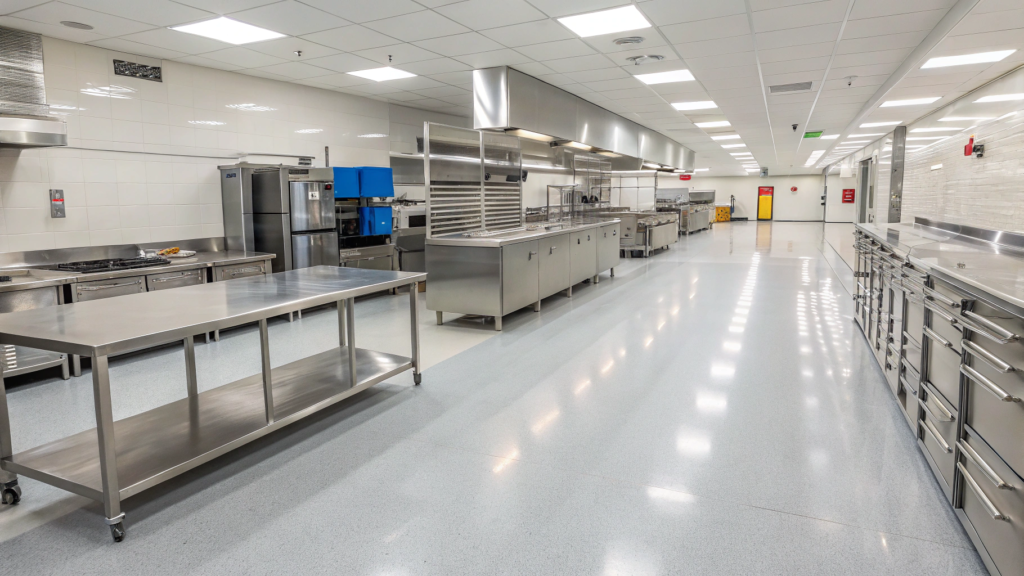
Mooloolaba’s hospitality scene is thriving — and the smartest operators are investing in the infrastructure that keeps it that way. Commercial epoxy flooring gives restaurants and cafés a seamless, food-grade surface engineered to handle the full demands of a working kitchen: heavy foot traffic, chemical cleaning agents, constant moisture, and the coastal humidity that accelerates wear on traditional concrete and tile.
The results speak for themselves. Queensland Health-compliant epoxy systems eliminate the grout lines where bacteria breed, meet the AS4586 slip-resistance standards required for commercial food-service environments, and deliver a surface that cleans down in minutes after a full service. This guide walks Mooloolaba hospitality operators through everything worth knowing — compliance requirements, cost comparisons, installation timelines, and the right questions to ask before committing to a contractor.
Is Epoxy Flooring Food Safe for Commercial Kitchens?
Yes — when correctly specified and installed, epoxy flooring is one of the most food-safe surfaces available for commercial kitchens. Here’s why Mooloolaba hospitality operators choose it:
- Seamless surface — no grout lines where bacteria, mould, or grease can accumulate
- Non-porous finish — resists absorption of oils, food acids, and cleaning chemicals
- Queensland Health compliant — meets food-premises standards under the Food Act 2006 (Qld)
- AS4586 slip-resistance rated — mandatory for wet commercial kitchen environments
- Chemical resistant — withstands commercial degreasers, sanitisers, and hot water washdowns
- HACCP compatible — supports hygiene management system requirements
Food Safety Requirements for Commercial Kitchens
What Queensland Health Inspectors Look For
Every commercial kitchen operating in Queensland is subject to inspection under the Food Act 2006 (Qld) and the Australia New Zealand Food Standards Code. Inspectors are specifically looking for surfaces that are smooth, impervious, and easy to clean — three qualities that traditional tiled or bare concrete floors consistently fail to deliver over time.
Grout lines are the most cited flooring issue in commercial kitchen inspections across Queensland. Grease, food particles, and moisture accumulate in grout joints, creating ideal conditions for bacterial growth. A fully seamless epoxy system eliminates that problem entirely, presenting inspectors with a surface that has no joints, no cracks, and no ingress points for contamination.
Epoxy also handles the thermal demands of a working kitchen — hot water washdowns, steam, and temperature cycling between cooking and refrigerated areas — without cracking, delaminating, or losing its hygienic properties. For a full overview of what Queensland Health requires for food premises surfaces, the Queensland Health food safety guidelines are a practical reference point before any commercial kitchen renovation.
Health Department Compliance Standards
AS4586 Slip Resistance — What the Rating Means
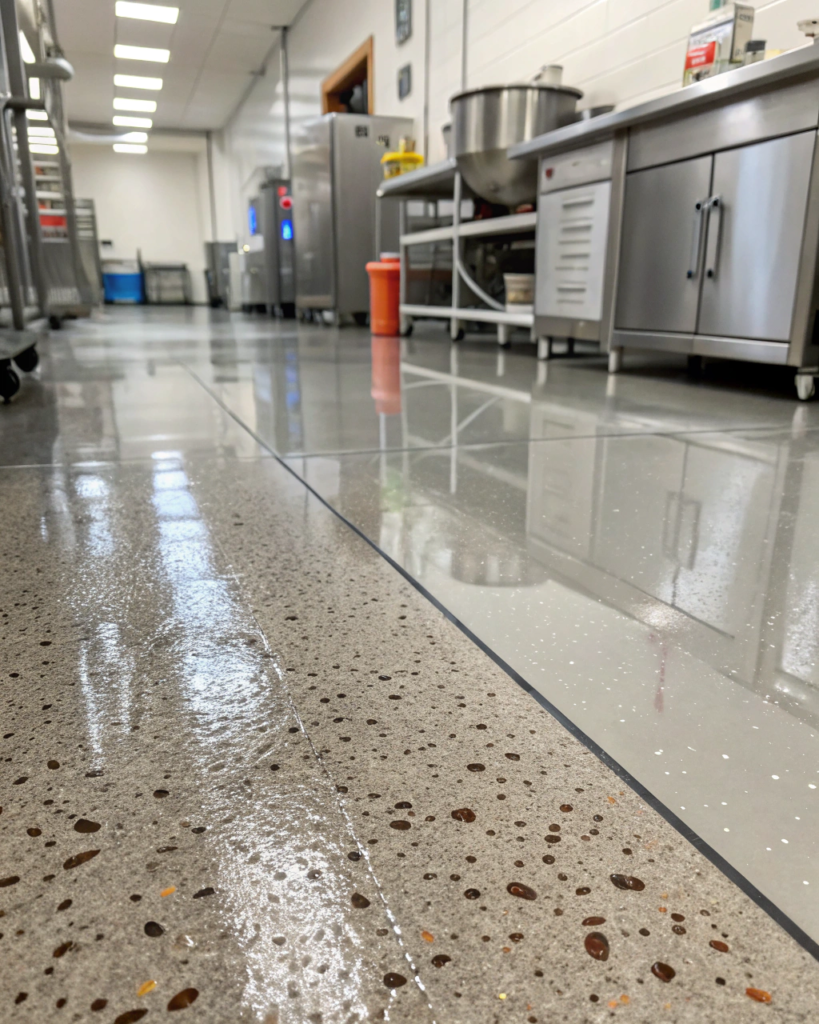
Slip resistance is not optional in a commercial kitchen — it’s a legal requirement. Standards Australia AS4586 classifies surfaces by their wet pendulum test result, and Queensland’s Workplace Health and Safety Act 2011 mandates appropriate ratings for food-service environments.
For back-of-house kitchen areas, a P4 or P5 wet pendulum rating is required — meaning the surface maintains traction even when wet with water, oil, or cleaning solution. For front-of-house dining areas and bar floors, a P3 rating is typically sufficient, though operators near Mooloolaba’s beachfront foot traffic corridors should consider P4 as best practice.
Anti-slip aggregate broadcast into the epoxy topcoat achieves these ratings without compromising cleanability — a critical balance in food-service environments. The result is a surface that grips when it needs to and still cleans down to a hygienic finish during end-of-service washdowns.
Sunshine Coast Council DA Considerations
Any new commercial fit-out or substantial renovation in Mooloolaba will pass through Sunshine Coast Council’s development assessment process. Flooring specifications that reference compliance with AS4586 and the Food Act 2006 streamline that process significantly. Contractors who can supply a compliance specification document with your quote — as Sunshine Coast Garage & Epoxy Floors provides on every commercial kitchen project — reduce the back-and-forth with certifiers and help you reach opening day faster.
Slip-Resistant Solutions for High-Traffic Areas
Front-of-House vs Back-of-House Requirements
Not all zones in a hospitality venue carry the same slip risk — and a professional epoxy specification reflects that reality. Front-of-house dining floors experience moderate foot traffic and occasional beverage spills, making a decorative epoxy system with a P3-rated finish an ideal choice: visually striking, easy to maintain, and appropriately slip-resistant.
Back-of-house is a different environment entirely. Commercial kitchen floors face continuous wet conditions, heavy footwear, cooking oils, and vigorous washdowns. Here, the anti-slip aggregate loading increases, the coating thickness builds up, and the specification prioritises performance over aesthetics — though the two aren’t mutually exclusive with modern epoxy systems.
Anti-Slip Aggregates That Don’t Compromise Cleanability
One concern Mooloolaba café and restaurant owners raise regularly is whether a heavily textured anti-slip floor is difficult to clean. The answer depends entirely on aggregate selection and broadcast density. When correctly specified, aluminium oxide or quartz aggregate systems create a surface that grips underfoot but doesn’t trap grease or debris in deep recesses. End-of-service cleaning remains fast and effective — which matters when your team is finishing at midnight and starting again at six.
Easy Cleaning for Hospitality Environments
Daily Cleaning Protocols for Epoxy Kitchen Floors
One of the most immediate benefits Mooloolaba operators notice after an epoxy installation is how dramatically cleaning time drops. A seamless surface with no grout lines, no cracked concrete, and no absorbent substrate means that a standard end-of-service washdown — hot water, a commercial food-safe degreaser, and a squeegee — removes grease, food residue, and cleaning chemicals completely in a fraction of the time tiled floors require.
The daily protocol is straightforward: sweep or blow down loose debris, apply diluted food-safe degreaser, agitate with a mop or brush, and squeegee to the floor waste. No scrubbing grout joints. No re-sealing. No tile replacement. For a venue doing two services a day six days a week, that time saving accumulates into real operational value across a year.
Chemical Compatibility — What You Can and Can’t Use
Food-grade epoxy systems are engineered for the chemical environment of a working kitchen, but operators should be aware of compatibility. Approved cleaning agents include commercial degreasers (pH 7–12), food-safe sanitisers, hypochlorite solutions at standard dilutions, and hot water up to 80°C. Highly concentrated acids or undiluted industrial solvents applied repeatedly over time can break down the topcoat — though standard hospitality cleaning chemicals fall well within safe parameters. Sunshine Coast Garage & Epoxy Floors provides a chemical compatibility guide with every commercial kitchen installation, so your floor and cleaning chemistry stay matched from day one.
Durability Under Commercial Kitchen Conditions
Thermal Shock and Hot Water Washdown Resistance
Commercial kitchens are among the most thermally demanding environments a floor coating will ever face. Hot water washdowns at 60–80°C, steam from commercial dishwashers, and the temperature differential between cooking stations and cool room approaches all create stress on floor systems. Low-quality or incorrectly specified epoxy can crack, blister, or delaminate under repeated thermal cycling.
Food-grade epoxy systems specified for commercial kitchens — as distinct from residential or light commercial products — are formulated with greater thermal tolerance and inter-coat adhesion. Installed correctly over a properly prepared concrete substrate, they handle daily washdown temperatures without issue and maintain their seamless, hygienic profile across a lifespan of 10 to 15 years in active kitchen environments.
Impact and Abrasion Resistance for Heavy Equipment
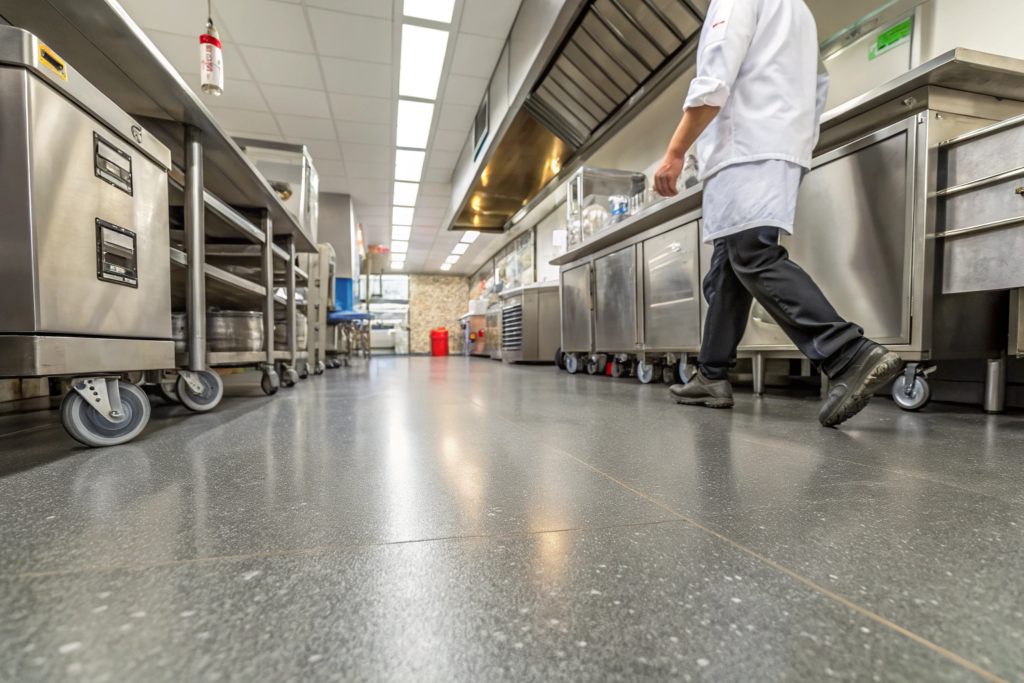
Dropped stock pots, trolley movement, and the concentrated load of commercial refrigeration units and cooking equipment put sustained pressure on kitchen floors. Modern epoxy build-ups of 3–5mm in commercial kitchen environments provide meaningful impact resistance and distribute point loads effectively across the concrete substrate below. For Mooloolaba venues operating in high-volume service environments — think busy waterfront cafés turning covers from breakfast through dinner — that combination of abrasion and impact tolerance means the floor performs at the end of year five exactly as it did at the end of week one.
Cost Analysis: Epoxy vs Traditional Restaurant Flooring
Upfront Cost Comparison
Across the Sunshine Coast, commercial epoxy flooring for restaurant and café environments typically runs $50–$90 per square metre, depending on surface preparation requirements, system specification, and total floor area. That positions it competitively against quality commercial tile — which includes materials, labour, grouting, and waterproofing — and above vinyl or painted concrete in upfront cost. The upfront number, however, is only part of the picture.
Lifetime Value — Maintenance and Downtime Factored In
The real cost comparison lives in the full lifecycle. Tiled floors in active commercial kitchens require ongoing grout re-sealing, individual tile replacement as cracking occurs, and periodic professional deep cleaning of grout joints — recurring costs that compound over five to ten years. Vinyl in commercial kitchen conditions chips, lifts at joins, and harbours moisture beneath the surface. Painted concrete can peel within 12–18 months under heavy washdown schedules.
A correctly installed commercial epoxy system carries minimal maintenance cost for a decade or more. Add in the value of reduced cleaning labour and the elimination of compliance risk from deteriorating surfaces, and the ROI case becomes straightforward for most Mooloolaba operators. Sunshine Coast Garage & Epoxy Floors completes most commercial kitchen epoxy installations within 2–4 days, with the floor ready for light use at 24 hours and full commercial service at 3–7 days — a significantly shorter closure window than a full tile replacement.
Why Mooloolaba Operators Choose Sunshine Coast Garage & Epoxy Floors
Local knowledge makes a measurable difference in commercial epoxy work. Sunshine Coast Garage & Epoxy Floors has been completing commercial kitchen and hospitality floor installations across Mooloolaba, Maroochydore, and the broader Sunshine Coast region for years — understanding the specific substrate conditions, coastal humidity factors, and compliance requirements that define this market.
Every commercial kitchen project includes a free on-site assessment, a written compliance specification referencing AS4586 and the Food Act 2006, and a detailed quote with no hidden additions. The team uses premium-grade, food-safe epoxy systems with manufacturer-backed warranties, applied by certified technicians with commercial kitchen experience.
Ready to upgrade your Mooloolaba restaurant or café floor? Call the team at Sunshine Coast Garage & Epoxy Floors on (07) 4158 6001 or visit epoxyflooringsunshinecoast.com to request your free commercial kitchen assessment.
📍 75 Tanawha Rd, Tanawha QLD 4556 | ☎ (07) 4158 6001 | Servicing Mooloolaba, Maroochydore & the entire Sunshine Coast

