
If you've ever walked into a workshop, café kitchen, or retail space and thought "wow,…
How Coastal Weather Affects Epoxy Flooring in Buderim
Buderim’s salt air, humidity and UV exposure are relentless — and standard concrete coatings weren’t built for it. Most homeowners don’t find out until they’re staring at a floor that’s peeling, cracking, or turning into a slip hazard.
Use the wrong epoxy or skip proper installation steps and you’re looking at a full redo inside 18 months. That’s not just wasted money — it’s your property value taking a hit over something that should’ve been a long-term fix.
This guide covers exactly which coastal conditions cause the most damage to epoxy flooring coastal weather Buderim properties, and what to look for in a system built to handle it. From salt air and humidity to UV and storm season — here’s what you need to know.
How Does Humidity Affect Epoxy Flooring?
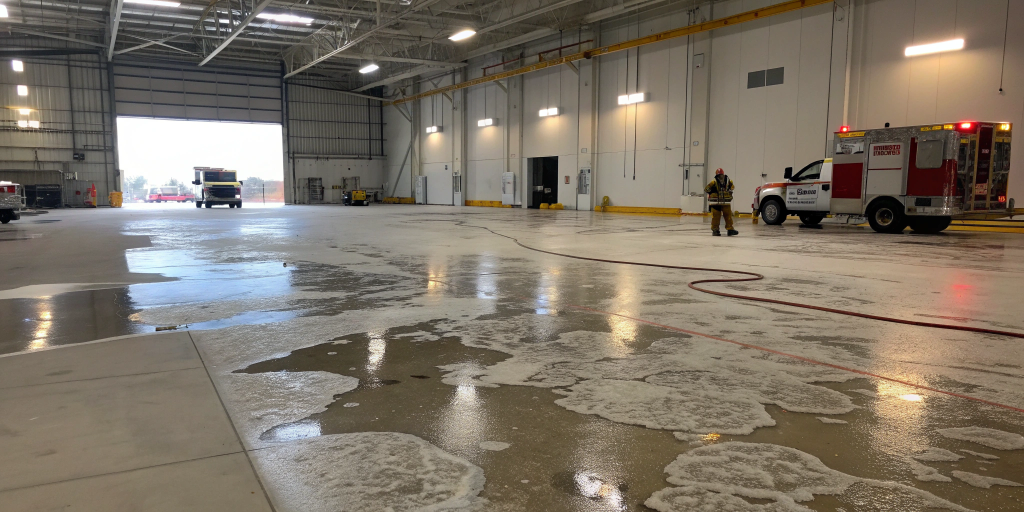
High humidity is one of the biggest risks to epoxy flooring on the Sunshine Coast — when moisture levels exceed 70–80%, the epoxy can’t cure properly, leading to visible failures and costly repairs.
Key humidity effects on epoxy floors:
- Amine blush — sticky or hazy film on the surface caused by moisture reacting with hardeners
- Blistering and bubbles — trapped moisture creates air pockets beneath the coating
- Soft or tacky finish — incomplete curing leaves the floor weak and easily damaged
- Peeling and delamination — poor adhesion caused by moisture in the concrete substrate
Professional installers manage this by keeping humidity between 50–60% and testing concrete moisture levels before any epoxy is applied.
Salt Air Damage to Concrete and Coatings
How Salt Particles Attack Unprotected Concrete
Salt air doesn’t just sit on the surface — it works its way into concrete pores over time, accelerating corrosion and spalling from the inside out. For Buderim homeowners, proximity to Mooloolaba and Maroochydore means year-round salt exposure, not just in summer. By the time you can see the damage, it’s already well underway.
Why Standard Garage Floor Paints Fail in Coastal Conditions
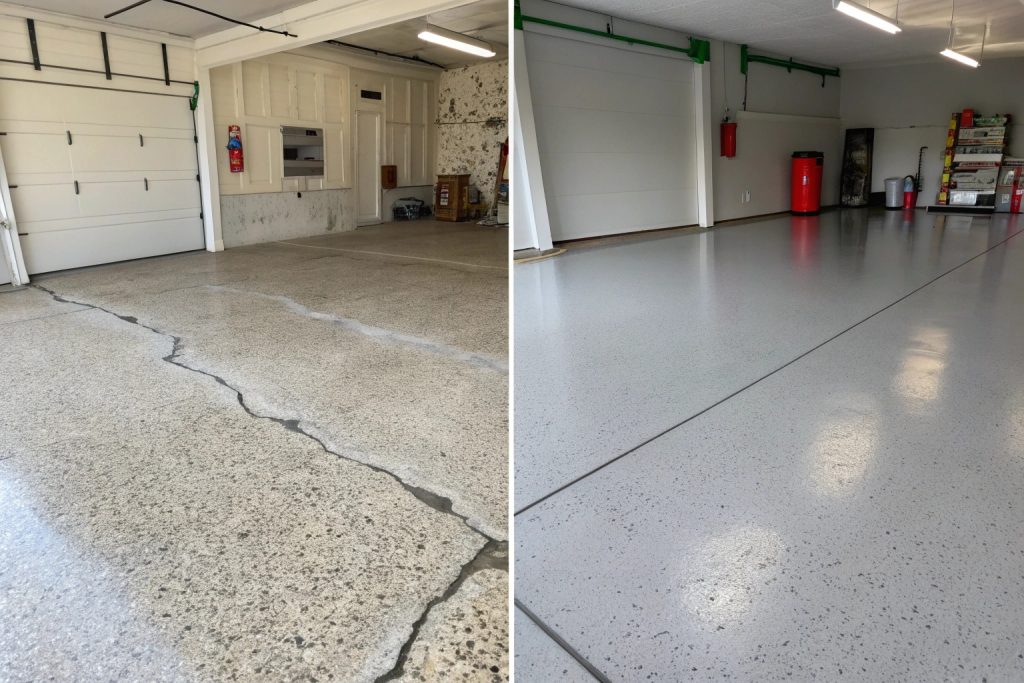
Standard acrylic paints don’t have the moisture vapour barrier needed to protect concrete in coastal environments. On the Sunshine Coast, that means a lifespan of 1–3 years at best — compared to 10–15 years for a quality epoxy system installed correctly. If your garage floor has been painted and repainted more than once, that’s why.
Humidity Challenges for Epoxy Installation
Sunshine Coast Humidity Levels and Epoxy Installation Windows
Sunshine Coast average humidity hits 65–80% through summer months — and that’s a serious problem for epoxy application. Experienced local installers schedule around seasonal humidity windows to avoid failures before they happen. DIY or amateur installs attempted during summer carry a high risk of exactly the kind of failures listed above: bubbling, peeling, soft finishes that never fully harden.
Moisture Testing Before Installation
Before any epoxy goes down, a professional installer will run a moisture vapour transmission test on the concrete substrate. It’s a straightforward process, but skipping it is one of the most common reasons coastal epoxy jobs fail. If your contractor doesn’t mention moisture testing before quoting, that’s worth paying attention to — because fixing a failed install costs more than getting it right the first time.
UV Exposure Effects on Flooring Systems
Queensland’s UV index is among the highest in the world, and it does a number on standard epoxy over time. What starts as a clean, glossy finish gradually yellows, chalks, and breaks down on the surface — not because the product failed exactly, but because it wasn’t rated for this kind of sun exposure. For a Buderim homeowner, that means a floor that looks tired and worn well before its time.
We use UV-stable aliphatic polyurethane topcoats on all our coastal installations. Unlike standard epoxy topcoats, aliphatic systems are specifically formulated to resist UV degradation — holding their colour and surface integrity far longer in Queensland conditions.
There’s also an important distinction between systems designed for indoor garages and those rated for outdoor surfaces like pool decks and patios. If we’re coating an outdoor entertainment area or pool surround, the system needs to be rated for full UV exposure and wet conditions from the ground up — not just an indoor product pushed outside.
Storm Damage Prevention with Quality Epoxy
Sunshine Coast storm season runs November through April, and unprotected concrete floors take a beating during that period. A quality epoxy system addresses this in several ways:
- Creates an impermeable barrier against storm water ingress and hydrostatic pressure
- Reduces cracking caused by water expansion and contraction cycles
- Multi-coat systems with broadcast aggregate provide impact resistance against hail and debris
- Protects the concrete substrate itself — not just the visible surface
Choosing Weather-Resistant Epoxy for Buderim
What to Look for in a Coastal Epoxy System
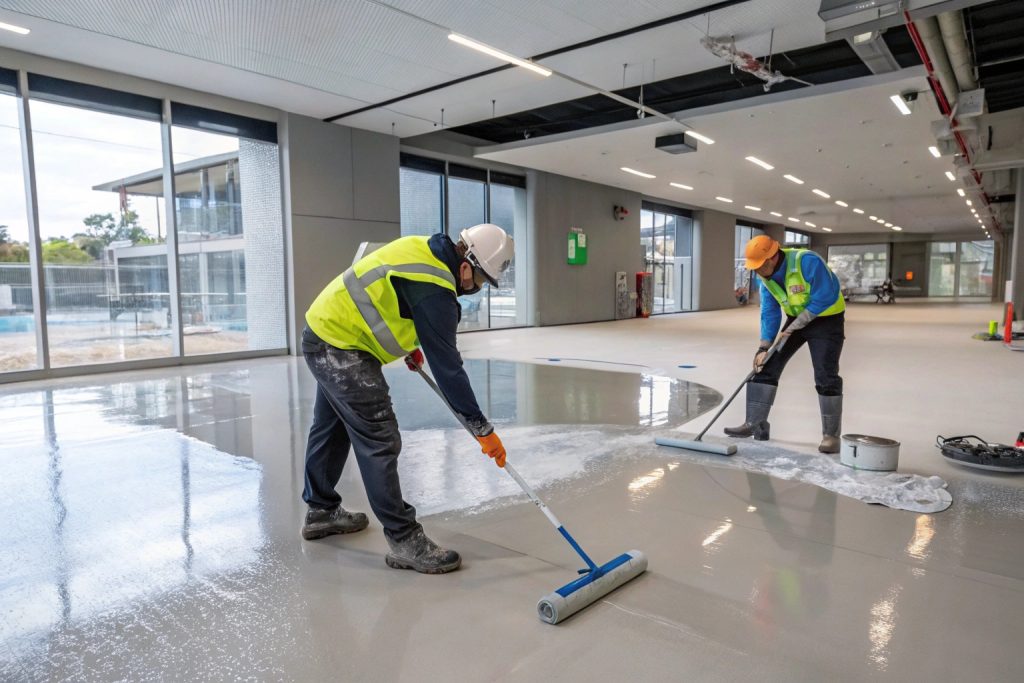
At minimum, a coastal-rated system needs three things: a moisture vapour barrier primer, a high-solids epoxy mid-coat, and a UV-stable polyurethane topcoat. For wet areas and outdoor surfaces, the system should meet AS/NZS 4586 slip resistance requirements.
Questions to Ask Your Epoxy Contractor in Buderim
Before you commit to any contractor, get answers to these:
- Do you test for moisture before installation?
- What topcoat do you use for UV resistance?
- What warranty do you offer for coastal installations?
- Can you provide local Sunshine Coast references?
A Buderim homeowner with a double garage 200 metres from the waterfront came to us after two failed DIY coating attempts. After proper moisture testing and a three-coat coastal system, that floor has held up through two full storm seasons without a single issue.
Maintenance Tips for Coastal Epoxy Floors
A properly installed coastal epoxy floor is one of the lowest maintenance surfaces you can have — and that’s not a sales pitch, that’s just what a good system delivers. Routine cleaning is straightforward: a pH-neutral cleaner on a monthly basis at minimum. Coastal properties pick up salt residue faster than inland homes, so staying on top of that monthly clean protects the topcoat over the long term. For slip resistance compliance on coastal floors, WorkSafe Queensland sets the standard for both residential and commercial surfaces
Once a year, give the floor a proper inspection. What we’re looking for is micro-cracking at the edges, any dulling of the topcoat, and lifting near expansion joints. None of those are emergencies if you catch them early — a minor repair at the right time avoids a full recoat down the track.
Get a Free Coastal Epoxy Assessment for Your Buderim Property
If your garage or outdoor floor is showing signs of salt damage, peeling, or general wear — don’t wait until it’s a full replacement job. We offer free on-site quotes across Buderim and surrounding Sunshine Coast suburbs, with honest advice on what your floor actually needs.
Call us today: 0741586001
We proudly service Buderim, Mooloolaba, Noosa, Caloundra and surrounding Sunshine Coast suburbs. We respond to all enquiries within 24 hours.
Not sure which system suits your Buderim property? Give us a call for honest advice — no obligation.

