
Outdoor Epoxy Coating Mooloolaba: UV-Resistant Solutions Built for Queensland Sun Outdoor epoxy coating in Mooloolaba…
Commercial Epoxy Flooring Nambour | Business Solutions
Walk into any thriving Nambour business — a busy workshop off Coronation Avenue, a food prep kitchen near the CBD, a retail showroom along Currie Street — and you’ll notice something. The floor tells you everything. A cracked, oil-stained slab says “we cut corners.” A clean, sealed epoxy surface says “we take this seriously.” One local auto mechanic told us he lost a major fleet contract simply because the client walked through his workshop and didn’t like what he saw underfoot. That one floor cost him thousands in recurring business.
Commercial epoxy flooring Nambour businesses are investing in isn’t just about aesthetics — it’s about compliance, safety, staff retention, and real return on your investment. Whether you’re running a food service operation, a trade workshop, or a retail space, this guide breaks down exactly what you need to know before you pour a single dollar into your floors.
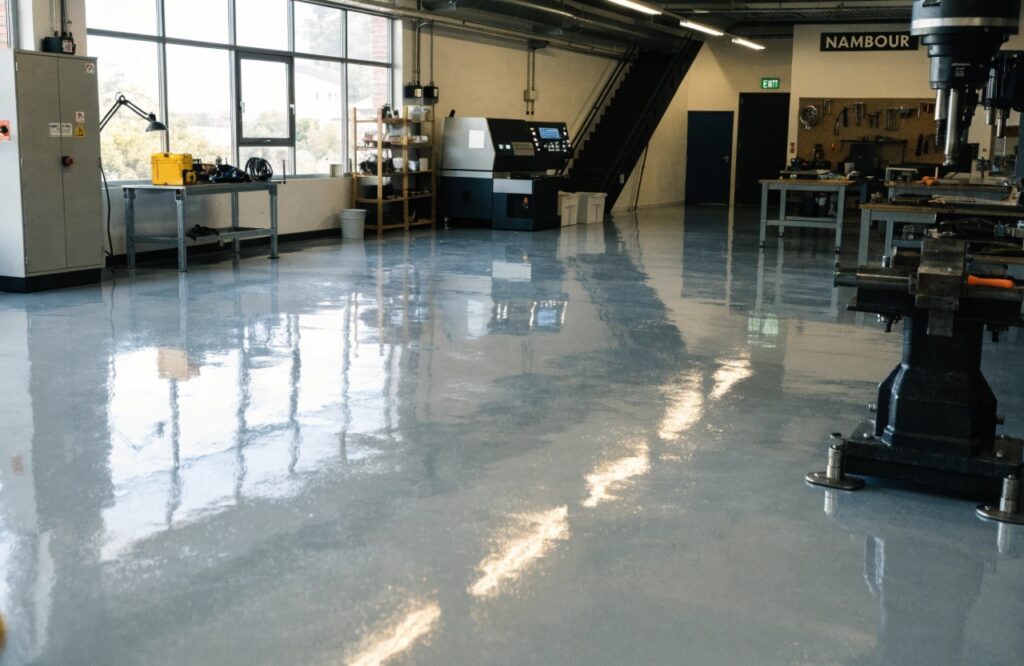
Heavy Traffic Epoxy Systems for Nambour Businesses
Not all epoxy is created equal — and this is where a lot of Nambour business owners get burned. They see a residential garage job, love the look, and assume the same product will hold up in their workshop or warehouse. It won’t.
Commercial floors cop a punishment that residential floors never see. Forklifts, pallet jacks, heavy machinery, steel-capped boots twelve hours a day — that’s a completely different load category. The epoxy systems built for these environments are typically:
- 100% solids epoxy — no water or solvents, meaning higher density and far greater durability
- Multi-coat systems — a primer coat, build coat, and topcoat working together rather than a single-layer application
- Broadcast aggregate finishes — quartz or aluminium oxide broadcast into the surface for grip and wear resistance
- Thickness ratings of 3mm–6mm — compared to the 1mm–2mm common in residential installs
For Nambour’s light industrial precinct and trade-heavy businesses around the Coronation Drive corridor, a minimum 3mm system is the baseline recommendation. High-impact zones — like loading docks or vehicle entry points — often need a cementitious urethane underlay before the epoxy goes down, especially where heavy point loads or thermal shock from cold storage are a factor.
The other thing worth knowing is UV stability. Queensland sun is no joke, and any commercial space with skylights or roller door exposure needs a UV-stable polyurethane topcoat. Standard epoxy yellows and chalks under UV — it looks terrible within twelve months and you’ll be back to square one.
Food Service and Health Department Compliance
If you’re running any kind of food-related business in Nambour — a café, commercial kitchen, food manufacturing facility, or even a bakery with a prep area — your floors aren’t just a cosmetic decision. They’re a compliance issue. Queensland Health food business requirements under the Food Act 2006 mean that local council inspectors will look at your floors, and the wrong surface can cost you your food licence.
Here’s what the regulations broadly require for food handling areas:
- Non-porous surfaces that can’t harbour bacteria or absorb liquids
- Seamless construction — grout lines and joins are contamination traps
- Chemical resistance to commercial cleaning agents, degreasers, and sanitisers
- Coved skirting where the floor meets the wall, eliminating the gap where grease and moisture collect
- Slip resistance ratings that meet Australian Standard AS 4586 for wet areas
Epoxy ticks every one of those boxes — but only when it’s specified and installed correctly. A food-grade epoxy system uses antimicrobial additives in the resin and a smooth, sealed finish that can withstand daily washdowns with harsh chemicals without degrading. The coved skirting is applied as part of the same system, so there are no joins, no gaps, and nothing for an inspector to flag.
One thing Nambour food business owners often overlook is drainage compatibility. Your floor needs to slope correctly toward drains — typically a 1:100 fall — and the epoxy needs to be feathered into the drain channel without creating a lip or pooling point. Getting this wrong means water sits on your floor, which is both a hygiene risk and a slip hazard.
The investment in a properly compliant food-grade floor pays for itself the first time you sail through an inspection rather than scrambling to fix deficiencies before your next audit.
Minimising Business Disruption During Installation
This is the number one concern we hear from Nambour business owners, and it’s a fair one. You can’t just shut the doors for a week — staff need to get paid, customers need to be served, and every day offline is money walking out the door. The good news is that a well-planned commercial epoxy installation doesn’t have to bring your operation to a standstill.
The key is staging. Rather than treating your floor as one big project, a good installer will break it into zones and work around your schedule:
- After-hours and weekend installation — most commercial jobs in active businesses are done outside trading hours entirely
- Section-by-section curing — modern epoxy systems can be touch-dry in four to six hours and back under foot traffic within 24 hours, so zones can be handed back progressively
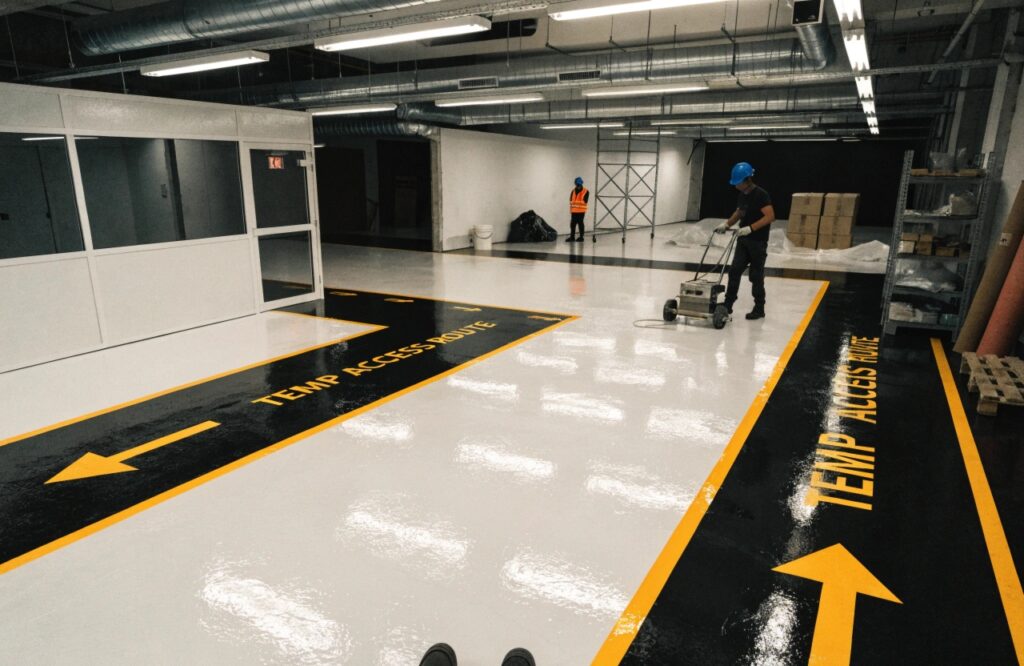
- Temporary access routes — clearly marked pathways keep staff and customers moving safely while adjacent sections cure
- Pre-installation prep work — grinding, patching, and moisture testing can often be done in stages before the epoxy pour even begins
For Nambour businesses that genuinely can’t afford any downtime — medical centres, 24-hour operations, food businesses mid-season — there are fast-cure epoxy systems that compress the timeline significantly. These use different catalyst ratios to hit recoat windows in two to three hours rather than the standard six to eight. The tradeoff is cost and a slightly tighter application window for the installer, but for the right business the premium is absolutely worth it.
The honest conversation to have with your installer upfront is this: tell them exactly what your trading hours are, which areas are non-negotiable, and what your absolute deadline is. A professional commercial flooring contractor will build their schedule around your business — not the other way around.
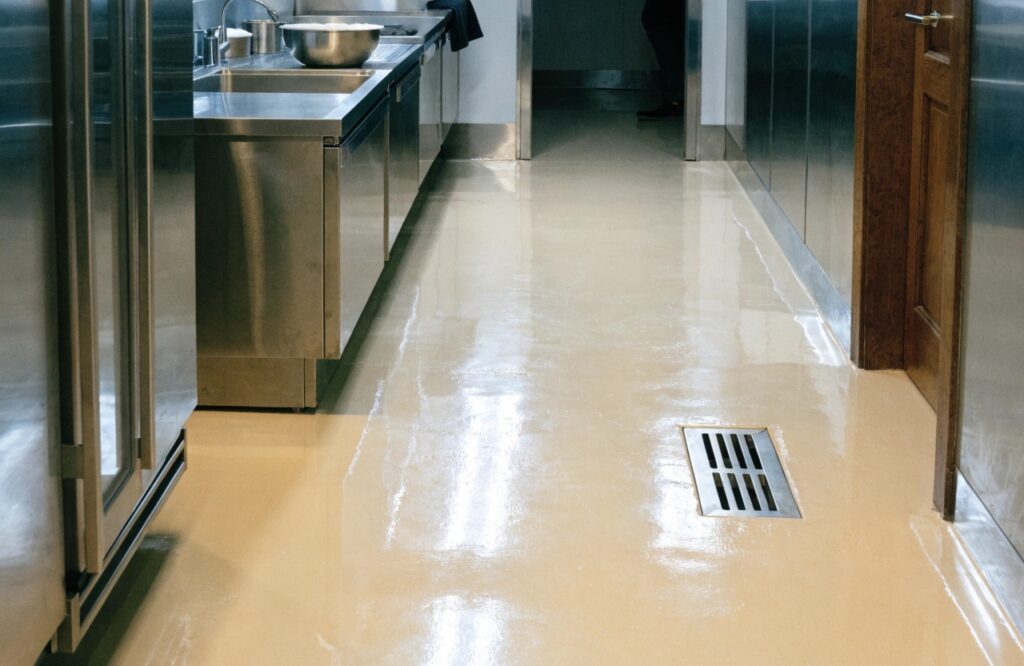
Commercial Epoxy Maintenance Programs
One of the biggest selling points of commercial epoxy flooring — and one that often gets glossed over in the sales conversation — is how low-maintenance it actually is compared to bare concrete or other flooring options. But low-maintenance doesn’t mean no maintenance, and Nambour business owners who treat it that way end up replacing their floors way sooner than they should.
A proper commercial maintenance program has three layers:
Daily:
- Dry sweep or auto-scrubber pass to remove abrasive grit and debris
- Spot clean spills immediately — epoxy resists staining but prolonged chemical contact can dull the topcoat over time
- Check high-traffic entry points for tracked-in moisture or contaminants
Monthly:
- Full wet mop or scrubber wash with a pH-neutral cleaner — avoid bleach-based products on coloured systems as they can fade pigment over time
- Inspect for any chips, scratches, or areas where the topcoat is thinning
- Check coved skirting joins and drain edges for any lifting or separation
Annually:
- Professional inspection of the full system, particularly in high-impact zones
- Topcoat refresh if surface sheen has dulled significantly — this is a fraction of the cost of a full re-coat and extends system life considerably
- Re-application of anti-slip aggregate in areas showing wear
For Sunshine Coast businesses dealing with Queensland’s humidity and salt-laden air, that annual inspection matters more than it would in a dryer inland climate. Moisture vapor transmission from the slab can slowly compromise adhesion from underneath if the system isn’t checked periodically — particularly in older buildings near Nambour’s lower-lying areas where the water table sits higher.
The businesses that get fifteen-plus years out of a commercial epoxy floor are the ones who treat maintenance as part of the asset, not an afterthought.
Safety Requirements and Non-Slip Solutions
Workplace safety in Queensland isn’t optional, and your floor is a frontline safety asset. Safe Work Australia data consistently shows that slips, trips, and falls are among the most common causes of workplace injury — and in wet or greasy commercial environments like workshops, kitchens, and warehouses, the floor surface is often the deciding factor between a near-miss and a workers’ compensation claim.
For Nambour businesses, the relevant benchmark is Australian Standard AS 4586, which classifies slip resistance across a range of wet and dry conditions. Commercial epoxy systems can be specified to hit different ratings depending on your environment:
- P3 rating — suitable for low-risk commercial areas like retail showrooms and dry warehouses
- P4 rating — recommended for commercial kitchens, bathrooms, and areas with regular wet traffic
- P5 rating — required for high-risk wet environments like food processing facilities and wash-down areas
The way slip resistance is built into an epoxy floor matters too. There are three main approaches:
- Broadcast aggregate — quartz or aluminium oxide crystals scattered into the wet topcoat before it cures, creating a textured surface that grips underfoot
- Anti-slip additive in the topcoat — mixed directly into the resin for a more uniform finish with moderate grip
- Shark grip or similar surface-applied products — used as a retrofit solution on existing floors, though less durable than built-in options
Beyond slip resistance, a well-specified commercial floor also contributes to broader safety compliance. High-visibility epoxy colours can be used to mark pedestrian walkways, forklift zones, hazard areas, and emergency exit routes — all requirements under Queensland workplace health and safety guidelines that WorkSafe Queensland actively enforces.
The right floor doesn’t just protect your staff. It protects your business from the kind of liability that comes when someone goes down on a slippery surface and your insurer starts asking questions about your safety documentation.
ROI Analysis for Commercial Property Owners
Let’s talk numbers, because at the end of the day that’s what drives commercial decisions. A quality commercial epoxy flooring system in Nambour will typically run between $50 and $120 per square metre depending on system specification, surface preparation required, and access conditions. For a 200sqm workshop floor, you’re looking at a $10,000–$24,000 investment. That sounds significant until you stack it against what you’re actually getting back.
Direct cost savings:
- Bare concrete requires sealing every two to three years — epoxy lasts ten to fifteen years with basic maintenance
- Reduced cleaning labour — sealed surfaces clean in a fraction of the time of porous concrete
- Lower workers’ compensation risk — fewer slip incidents means fewer claims and potentially lower premiums over time
- Equipment protection — dust and moisture off unsealed concrete accelerates wear on machinery and vehicles
Indirect value gains:
- Professional appearance that wins clients and retains staff
- Compliance readiness that avoids costly deficiency rectifications
- Property value uplift for owned commercial premises
- Faster, easier facility inspections across food, health, and safety categories
For commercial property owners specifically, a well-maintained epoxy floor is a legitimate asset that shows up in facility assessments and lease negotiations. Tenants pay more for premises that are clean, safe, and move-in ready — and a quality floor is one of the first things a prospective tenant notices.
The businesses that hesitate on this investment because of upfront cost almost always come back having spent more money maintaining a deteriorating slab than a proper epoxy system would have cost them in the first place.
Ready to Upgrade Your Nambour Business Floor?
Commercial epoxy flooring is one of the smartest investments a Nambour business owner can make — not just for appearances, but for safety compliance, operational efficiency, and long-term property value. Whether you’re running a food operation that needs to pass its next inspection or a trade workshop that wants a floor tough enough to handle whatever gets thrown at it, the right epoxy system will deliver for years.
Get in touch with our team today for a free on-site assessment and quote tailored to your specific business environment. We work around your trading hours, stage the installation to minimise disruption, and back every commercial job with a written warranty.
Your floor is working every single day — it’s time it started working for you.


Comments (0)