
If you've ever walked into a workshop, café kitchen, or retail space and thought "wow,…
Epoxy Flooring Coastal Areas Queensland: What You Need to Know Before You Coat
My neighbour Craig had his garage floor coated a few years back. Looked incredible for about eight months — then the salt air got to it. The coating started peeling at the edges, went cloudy in patches, and by the second summer it looked worse than the bare concrete he started with. Turned out the contractor used an inland-grade system on a property two streets from the beach. Cost him the same money twice.
That’s the thing about epoxy flooring in coastal areas Queensland — it’s not just about picking a colour and booking a date. The environment here is genuinely aggressive. Salt, humidity, UV, moisture pushing up from below. What works fine in Toowoomba or western Brisbane can fail fast in Nambour. This article breaks down exactly what you need to know so you don’t end up like Craig.
How Salt Air Affects Different Flooring Materials
Salt air isn’t just a smell — it’s a chemical process that quietly destroys surfaces over time. The closer you are to the ocean, the more sodium chloride particles are suspended in the air, and those particles land on every surface around your home. Including your garage floor.
Here’s how different materials hold up:
| Flooring Type | Salt Air Weakness | Typical Lifespan Coastal QLD |
| Bare concrete | Spalling, cracking, surface erosion | 10–15 years before major repair |
| Standard paint | Peeling, bubbling, adhesion failure | 1–3 years |
| Inland-grade epoxy | Delamination, clouding, edge lift | 2–5 years |
| Marine-grade epoxy | Minimal degradation with maintenance | 10–15+ years |
| Polyaspartic topcoat | UV and salt resistant | 10–15+ years |
Bare concrete is actually more vulnerable than most people think. Salt air accelerates the carbonation process in concrete — it pulls moisture in, expands when it freezes or heats up, and the surface starts to spall. You’ll see it as pitting, flaking, and those white chalky deposits along edges and joins.
Standard floor paint fails even faster because it sits on top of the concrete rather than bonding chemically with it. Once salt air gets under the edges — and it always does — it lifts from the bottom up. That’s exactly what happened to Craig’s floor.
The difference with a properly specified marine-grade epoxy system is penetration and flexibility. The coating bonds into the concrete at a chemical level, and the right formulation has enough flex to handle thermal cycling — that’s the daily expansion and contraction your slab goes through in Queensland heat — without cracking or lifting.
UV-Resistant Epoxy Systems for Queensland Sun
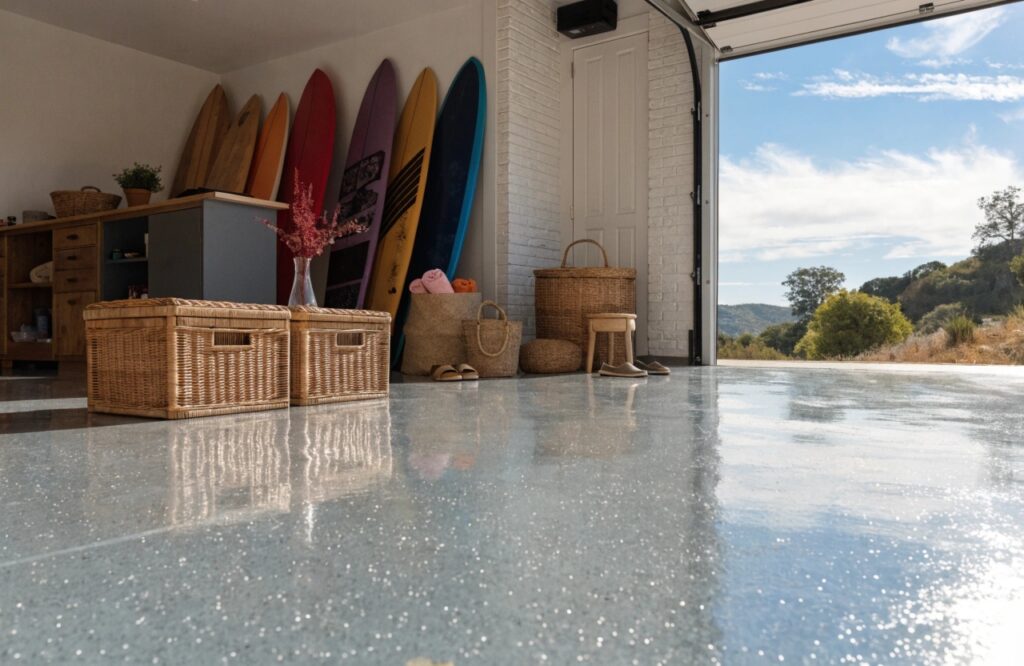
Here’s something a lot of homeowners don’t realise until it’s too late — standard epoxy yellows in direct sunlight. Not gradually either. You can have a brand new coating that starts going amber within a single Queensland summer if the wrong system gets specified.
The UV index on the Sunshine Coast regularly hits 11 and above during summer — that’s extreme on the global scale, and it does real damage to coatings that aren’t formulated for it.
What to look for in a UV-stable system:
- Aliphatic polyurethane or polyaspartic topcoats — these are UV-stable by chemistry, not just by additive. They won’t yellow or chalk under direct sun exposure
- 100% solids epoxy base coat — thicker film build means more protection against UV penetration reaching the concrete below
- Light-reflective colours — darker colours absorb more heat, which accelerates thermal cycling and puts more stress on the coating bond
- Minimum 2-coat system — a single coat epoxy on an outdoor or semi-exposed slab in coastal Queensland is always a compromise
Garages with east or west-facing doors get a particularly hard run because the slab near the entrance is exposed to direct morning or afternoon sun for hours at a time. That transition zone — where coated meets uncoated or exposed — is where UV failure tends to start first.
If your garage opens to the north, congratulations, you’ve got the worst of it. Worth budgeting for a full polyaspartic topcoat over your epoxy base, not just a standard clear seal.
Humidity Considerations for Sunshine Coast Installations
The Sunshine Coast averages around 70% relative humidity through summer. That number matters a lot more than most people think when it comes to epoxy flooring.
Epoxy is moisture-sensitive during application. If the concrete slab has too much moisture content, or if humidity is too high when the coating gets laid down, you get adhesion failure. Not immediately — usually three to six months later when it starts bubbling up from underneath and you’re left wondering what went wrong.
The two moisture problems to know about:
- Atmospheric humidity — affects the coating as it cures. Most epoxy systems have an application window with a humidity ceiling, typically around 85%. On a humid Sunshine Coast morning that’s not as much buffer as it sounds
- Substrate moisture — water vapour pushing up through the slab from below. This is especially common in older properties, slabs without proper vapour barriers, and low-lying blocks near waterways or the coast
A reputable installer will test your slab moisture levels before they quote, not after they’ve already mixed product. Moisture content thresholds before coating are covered by Australian Standard AS 1884 — the Cement Concrete & Aggregates Australia publishes free technical guidance on concrete moisture behaviour that’s worth understanding before you book anyone in. If a contractor skips that testing step entirely, that’s a red flag worth taking seriously.
Timing of installation also matters. Experienced local installers generally schedule coastal jobs for cooler months or early mornings — lower ambient humidity gives the coating the best possible cure conditions. A rushed wet-season install to suit someone’s schedule is a recipe for a warranty dispute six months down the track.
Case Studies: 10+ Year Performance in Coastal Properties
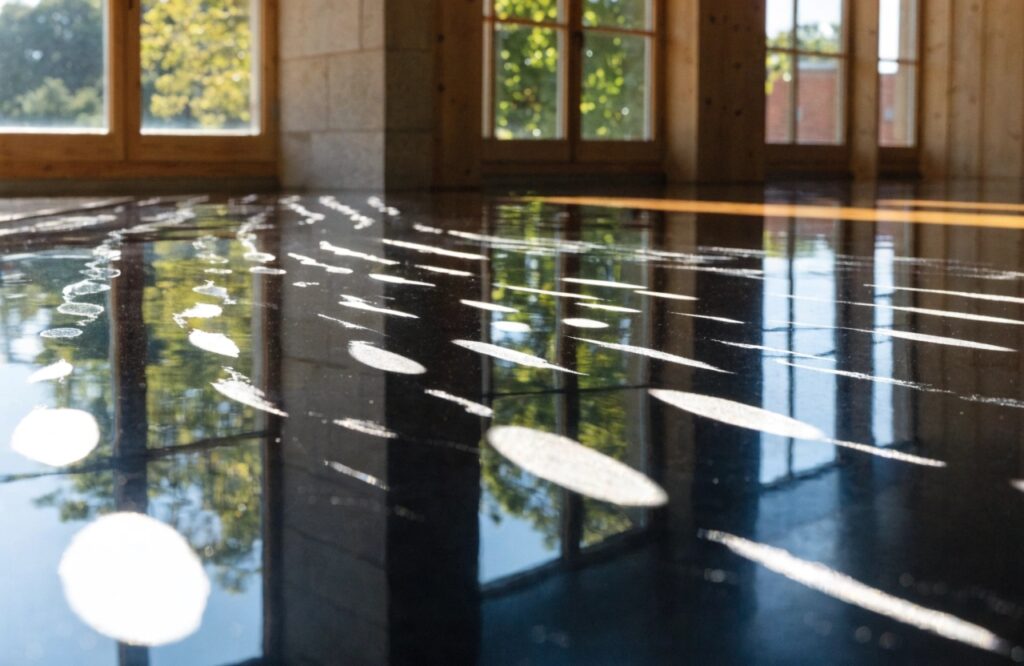
Real-world performance on the Sunshine Coast tells you more than any product data sheet. Here’s what properly specified systems actually look like after years of coastal exposure.
Mooloolaba residential garage — 11 years post-install
Double garage, 200 metres from the beach. Owner went with a broadcast flake system over a moisture-tolerant epoxy base with a polyaspartic topcoat. Eleven years later the floor has been resealed once. No delamination, no edge lift, no clouding. The only visible wear is light surface scuffing near the door threshold from foot traffic — which is exactly where you’d expect it.
Caloundra home workshop — 8 years post-install
North-facing slab, direct afternoon sun exposure for four to five hours daily. Owner specified an aliphatic urethane topcoat specifically for UV resistance. Colour has held, no yellowing, coating integrity still solid. The owner did note some minor surface dulling near the door after year six — addressed with a maintenance coat, which added another estimated five to eight years of life.
Buderim investment property — 12 years across three tenancy cycles
Investor wanted a floor that wouldn’t need replacing between tenants. Went with a high-build commercial-grade system. Through three separate tenancies including one tenant running a home-based mechanic hobby, the floor has held. Total maintenance spend over twelve years — one professional clean and inspect.
The common thread across all three? Proper surface prep, correct product specification for the coastal environment, and moisture testing before application. None of them were the cheapest quote on the day.
Maintenance Requirements in Marine Environments
The good news is that a properly installed coastal epoxy system is genuinely low maintenance. The bad news is that “low maintenance” still means something — it’s not zero maintenance, and skipping the basics shortens the lifespan significantly.
What a basic maintenance routine looks like:
- Weekly sweep or blower — salt particles that settle on the surface are abrasive. Regular removal stops them grinding into the topcoat every time someone walks or drives across it
- Monthly mop with pH-neutral cleaner — avoid anything acidic or bleach-based, both will degrade the topcoat over time
- Annual inspection — check edges, joins, and the threshold zone near the door for any early signs of lifting or micro-cracking
- Reseal every 5–7 years — a maintenance topcoat is far cheaper than a full system replacement and can effectively reset the clock on surface wear
Salt residue is the main enemy in day-to-day terms. If you’re close to the beach, your car is bringing salt water and salt air into the garage every single drive. That pools under the vehicle and sits on the coating. A quick mop after wet weather or beach trips makes a measurable difference over the years.
One thing worth knowing — harsh degreasers that tradies sometimes recommend for oil stains can strip the topcoat if used repeatedly. Warm water and a purpose-formulated epoxy cleaner handles most stains without the damage.
A good installer will walk you through a specific maintenance schedule for your system at handover. If they don’t, ask for one in writing. The manufacturers of quality systems publish maintenance guidelines, and following them is often a condition of the warranty staying valid.
Choosing the Right Epoxy Grade for Coastal Conditions
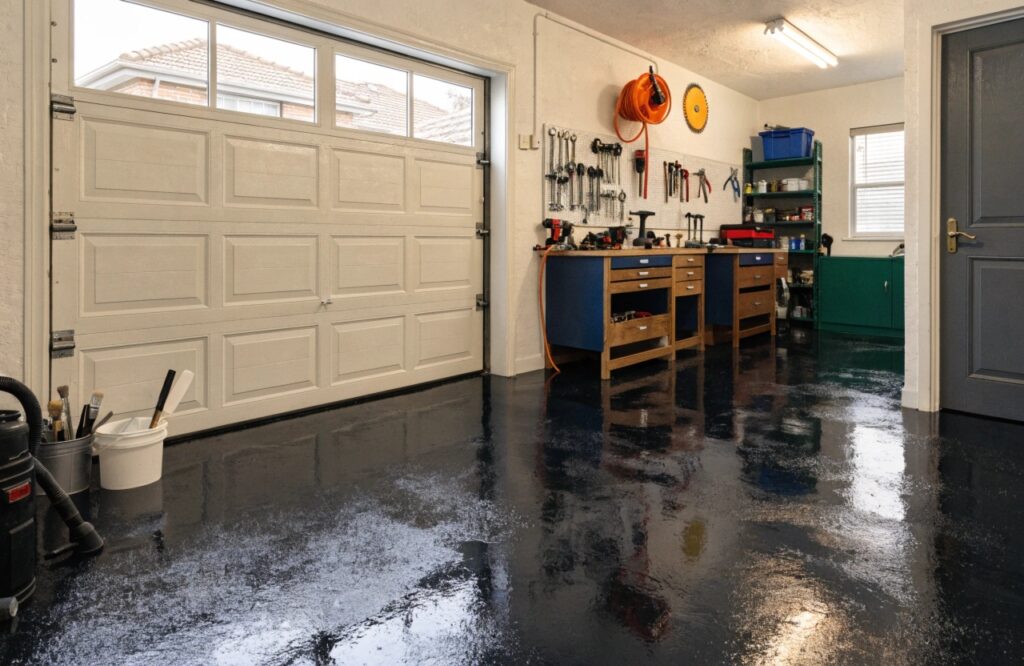
Not all epoxy products are created equal, and the grade you choose makes or breaks long-term performance in a marine environment. Here’s a straightforward way to think about it.
System tiers for coastal Queensland:
| Distance from Coast | Recommended System |
| 0–500 metres | Marine-grade epoxy base + polyaspartic topcoat |
| 500m–2km | High-build epoxy + aliphatic urethane topcoat |
| 2km–5km | Standard commercial epoxy + UV-stable topcoat |
| 5km+ | Standard residential system adequate |
The closer you are to the water, the more you need a system built specifically for salt air and humidity exposure — not just a residential product with a premium price tag attached.
Questions to ask any installer quoting your job:
- What moisture testing method do you use, and when do you test?
- Is the topcoat UV-stable or standard clear?
- What’s the application humidity ceiling for the products you’re using?
- Does the warranty cover coastal conditions specifically?
That last one catches a lot of people off guard. Some product warranties have fine print that excludes environments within a certain distance of the ocean. Worth reading before you sign anything.
Ready to Get It Right the First Time?
Coastal conditions are unforgiving, but the right epoxy system handles them well — and keeps handling them for a decade or more with basic care. The difference between a floor that lasts and one that fails inside five years usually comes down to product specification and prep work, not luck.If you’re in Nambour and want a straight conversation about what system suits your property, your slab, and your budget — give us a call. No pressure, no jargon, just honest advice from a team that works in this environment every day.

