
If you've ever walked into a workshop, café kitchen, or retail space and thought "wow,…
Coastal Epoxy Floors Mooloolaba | Salt Air Protection
Coastal Epoxy Flooring in Mooloolaba: A Salt Air Protection Guide for Sunshine Coast Property Owners
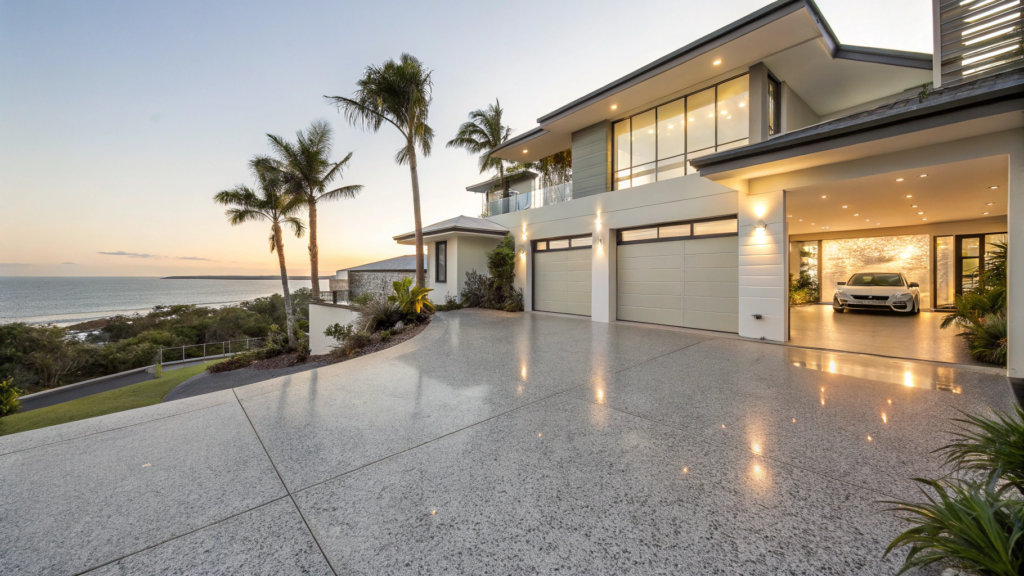
Living within a few kilometres of the Pacific is one of Mooloolaba’s great rewards — and one of the toughest tests a concrete floor will ever face. Salt-laden air, summer humidity, and intense UV all work quietly on unprotected slabs, year after year. The good news? Coastal epoxy flooring in Mooloolaba is engineered for exactly these conditions, giving Sunshine Coast property owners a floor that stays sharp, safe, and showroom-ready for the long haul.
In this guide, you’ll discover how marine-grade epoxy systems outperform standard coatings in coastal environments, why salt air is so hard on traditional flooring, and what to look for when choosing a system built for Mooloolaba’s microclimate. Whether you’re protecting a beachside garage, an entertaining area, or a coastal investment property, you’ll finish this article knowing exactly what works — and why.
Does Epoxy Flooring Work in Salt Air?
Yes — epoxy flooring works exceptionally well in salt air, provided the system is specifically formulated for coastal conditions. Marine-grade epoxy coatings are engineered to resist chloride penetration, UV degradation, and humidity-related bond failures that cause standard epoxy systems to deteriorate within a few years near the ocean.
For Mooloolaba and Sunshine Coast properties, a coastal-grade epoxy system typically delivers:
- 15–20+ years of service life when professionally installed on a sound substrate
- Chloride resistance that prevents salt from reaching the concrete and triggering spalling
- UV-stable topcoats (polyurethane or polyaspartic) that hold colour and gloss in direct sun
- Moisture tolerance during application is critical in humid coastal microclimates
- Slip resistance compliant with AS 4586 standards for wet and exposed areas
Standard hardware-store epoxy kits, by contrast, are not designed for coastal exposure and often fail within 18 to 24 months on Sunshine Coast properties.
Understanding Mooloolaba’s Coastal Climate Challenges
Mooloolaba sits in one of Queensland’s most beautiful — and most demanding — coastal microclimates. Properties from Cotton Tree through Alexandra Headland to Point Cartwright are exposed to a combination of conditions that few inland suburbs ever experience. According to the Bureau of Meteorology, the Sunshine Coast averages relative humidity above 70% for much of the year, with summer peaks regularly pushing higher during the wet season.
Layered on top of that humidity is something less visible but far more corrosive: airborne salt. Onshore winds carry fine salt aerosols inland, settling on every exposed surface. Properties within roughly 1 km of the coast — think the streets backing onto the Mooloolaba Esplanade or homes near the Maroochydore Marina District — experience the heaviest deposition, but salt influence extends several kilometres further inland.
Then there’s the Sunshine Coast sun. UV index readings here regularly hit extreme levels for much of the year, accelerating the breakdown of any surface that isn’t UV-stable. Add summer storms, occasional cyclonic systems, and the temperature swings between cool coastal mornings and hot afternoons, and you have a climate that punishes any flooring system not specifically engineered for the job.
For property owners, the takeaway is simple: coastal Mooloolaba conditions demand coastal-grade flooring solutions.
How Salt Air Damages Standard Flooring Systems
Salt air looks harmless, but its effect on concrete and standard coatings is relentless. The mechanism is straightforward: airborne chloride particles settle on concrete surfaces, dissolve into any available moisture, and slowly migrate into the slab. Over time, those chlorides reach the steel reinforcement beneath, triggering corrosion that expands and cracks the concrete from within — a process known as concrete spalling.
For homeowners, this typically shows up as hairline cracks in the garage floor that widen each year, flaking around expansion joints, or rust stains weeping through the surface. Standard hardware-store epoxy kits, designed primarily for inland workshops and DIY garages, rarely stand up to this assault. Most are formulated as basic two-pack systems without UV stabilisers, marine-grade resins, or the chemical resistance needed to lock chlorides out.
The result is a coating that may look impressive for the first 18 to 24 months, then begins to chalk, yellow, lift at the edges, or peel in patches where moisture has worked its way underneath. By year three, many coastal homeowners find themselves grinding the failed coating off and starting again.
The lesson from every Mooloolaba property where this has played out is the same: protection against salt air isn’t a finish you add at the end — it has to be engineered into the entire flooring system from the slab up.
Marine-Grade Epoxy Formulations vs Regular Systems
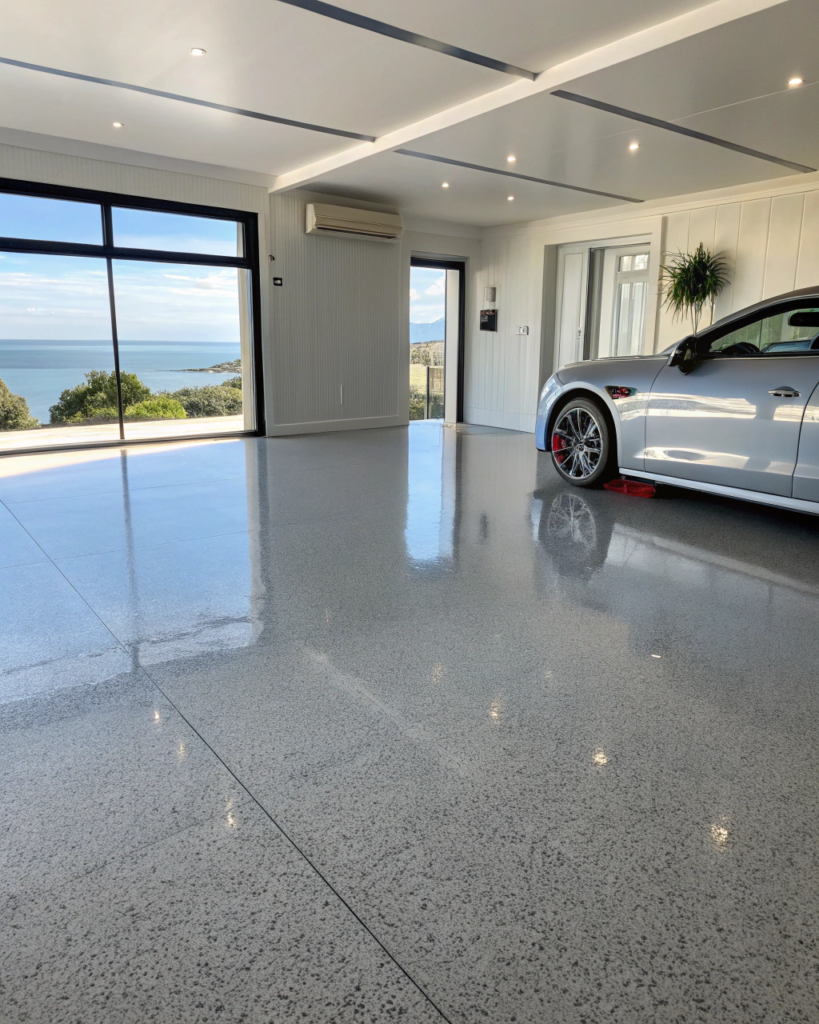
This is where coastal-grade systems earn their keep. Marine-grade epoxy isn’t a marketing label — it refers to formulations specifically engineered to handle chloride exposure, moisture vapour transmission, and constant humidity. The differences sit at the chemistry level, but the practical results are dramatic.
A standard residential epoxy is typically a two-pack system designed for clean, dry, climate-controlled garages. It bonds well in ideal conditions, but it lacks the moisture tolerance, chemical resistance, and UV stability that coastal Mooloolaba properties demand. A marine-grade or coastal-grade system, by contrast, is built around modified resins, often paired with a moisture-tolerant primer and finished with a UV-stable polyurethane or polyaspartic topcoat.
The build-up generally looks like this:
- A penetrating, moisture-tolerant primer that locks into the slab and blocks chloride migration
- A high-build epoxy body coat for impact and abrasion resistance
- A UV-stable topcoat — usually polyurethane or polyaspartic — that handles sun exposure and adds chemical resistance
Compliance also matters. Slip resistance should be specified to AS 4586 standards, particularly around wet areas, pool surrounds, and entryways. The result is a floor system that resists salt, shrugs off UV, handles humidity, and stays compliant with Australian safety expectations — exactly what a Mooloolaba property needs.
UV Protection for Sunshine Coast Properties
The Sunshine Coast records some of the highest UV index readings in the country, and the effect on flooring systems is just as significant as salt air. UV radiation breaks down the polymer chains inside standard epoxy resins, causing yellowing, chalking, and gradual loss of gloss. On any surface exposed to direct sunlight — outdoor entertainment areas, pool decks, alfresco zones, or garages with the door open most of the day — this matters enormously.
The chemistry that makes the difference comes down to two resin families. Aromatic resins, used in most standard epoxies, are inexpensive and tough but inherently UV-unstable. Aliphatic resins — typically found in polyurethane and polyaspartic topcoats — are engineered for sun exposure and retain their colour and clarity for years longer.
For Mooloolaba homeowners, this means any coating in a sun-exposed area should be finished with an aliphatic UV-stable topcoat. The base epoxy can still be aromatic — that’s where strength and adhesion come from — but the surface layer needs to handle the sun. The result is a floor that holds its colour, keeps its gloss, and resists the chalky, faded appearance that betrays an under-specified system.
It’s a small specification detail with a long-term payoff: floors that still look like the day they were installed, even after a decade of Sunshine Coast summers.
Humidity and Temperature Considerations
Coastal humidity doesn’t just affect a finished floor — it affects how that floor is installed in the first place. Epoxy chemistry is sensitive to ambient moisture, slab moisture content, and temperature, and getting any of these wrong during application leads to bond failures, blushing, milky finishes, or coatings that simply never cure properly. On the Sunshine Coast, where summer humidity can sit above 80% for days at a time, application timing is everything.
Professional installers manage this in several ways. Slab moisture is tested before any product touches the concrete, typically using calcium chloride or relative humidity probes. Dew point is monitored throughout the application to ensure surface temperatures stay above the threshold where condensation can form. Moisture-tolerant primers are specified for slabs that read higher than ideal — a common reality in Mooloolaba properties built on coastal sand profiles.
Temperature matters just as much. Apply a standard epoxy on a cool morning when the slab is still below the manufacturer’s minimum, and cure times stretch unpredictably. Apply it on a 35-degree afternoon and the pot life shrinks to minutes, leaving installers fighting the product.
The takeaway for coastal property owners is straightforward: marine-grade products and a skilled installer who understands Sunshine Coast conditions are what separate a floor that lasts twenty years from one that fails in two.
Long-Term Performance in Coastal Environments
Here’s the question every coastal homeowner ultimately wants answered: how long will it actually last? With a properly specified marine-grade system, professionally installed on a sound substrate, the realistic answer for a Mooloolaba property is fifteen to twenty-plus years of strong performance — and that’s with minimal maintenance beyond routine cleaning.
What does that look like in practice? Year one, the floor performs as new. Years two through ten, expect the surface to shrug off salt, UV, and daily wear with no visible degradation, provided you rinse it down every few months and address spills promptly. Around the ten-to-fifteen year mark, the topcoat may benefit from a refresh — a single recoat of the polyurethane or polyaspartic layer, which protects the body coat underneath and effectively resets the clock.
Compared to bare or sealed concrete, which typically shows visible salt damage within three to five years on coastal properties, the difference is substantial. For investors, this translates directly into lower maintenance costs across a portfolio. For homeowners, it means a garage, alfresco area, or pool surround that still looks magazine-worthy when the time comes to sell — protecting both lifestyle and resale value.
A coastal-grade epoxy floor is one of the few home improvements where the local Mooloolaba environment actually rewards specifying the higher-end system upfront.
Why Mooloolaba Property Owners Trust Epoxy Flooring Sunshine Coast
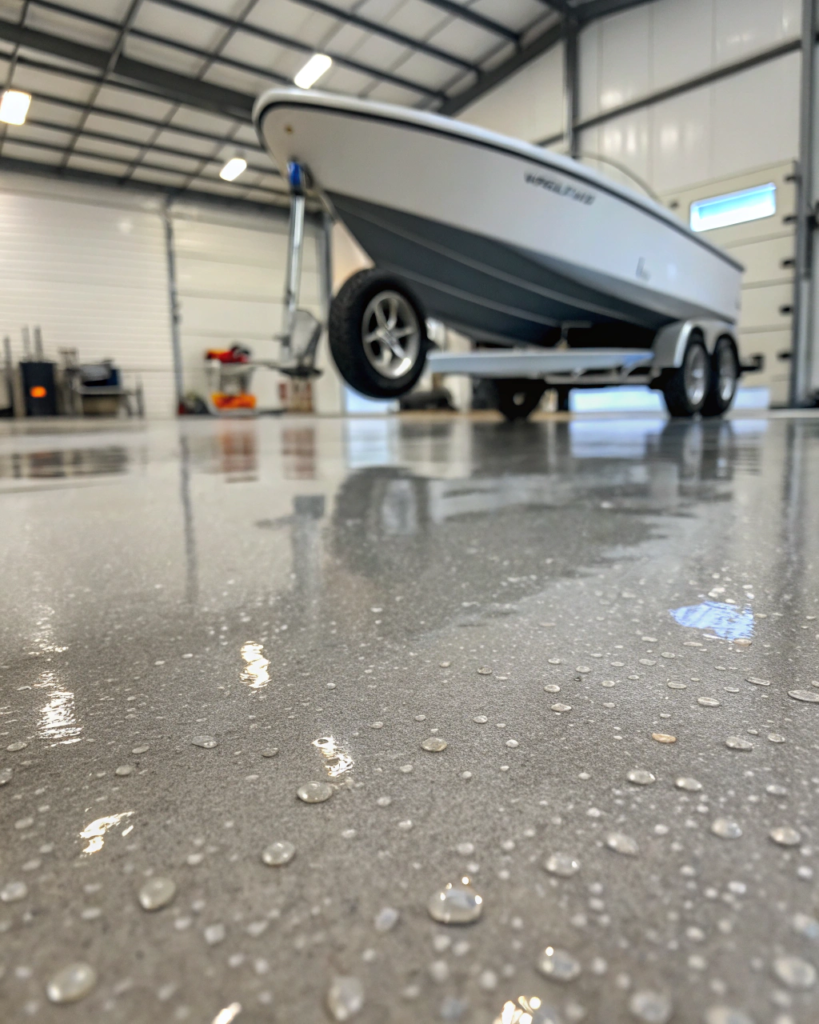
Choosing the right installer matters as much as choosing the right product. Coastal flooring is a specialist application, and the difference between a floor that lasts two decades and one that fails in two years almost always comes down to who applied it and what they specified.
Epoxy Flooring Sunshine Coast brings deep local experience to every Mooloolaba project — from beachside homes in Cotton Tree to investment properties along the Esplanade and family residences in Buderim. Every system is specified for the exact exposure conditions of your property, professionally installed by experienced applicators, and finished to comply with Australian standards, including AS 4586 slip resistance requirements for wet and exposed areas.
For homeowners, that means peace of mind. For investors, it means a floor system that genuinely performs across a fifteen-to-twenty-year horizon — protecting the asset and reducing turnover costs.
Ready to Protect Your Mooloolaba Property?
If you’re considering coastal epoxy flooring for your home, garage, alfresco area, or investment property, the smartest first step is a no-obligation on-site assessment. Coastal conditions vary significantly even within a few streets — a property in Alexandra Headland faces different exposure than one in Buderim or further inland — and the right specification depends on your slab condition, exposure, and intended use.
Get your free coastal property assessment today:
📍 Visit: 75 Tanawha Rd, Tanawha QLD 4556 📞 Call: 07 4158 6001 🌐 Online: epoxyflooringsunshinecoast.com
Whether you need a single garage transformed or a full coastal property protected from slab to surface, the Epoxy Flooring Sunshine Coast team will walk through the right system for your conditions, your budget, and your long-term plans.
Don’t wait for salt air to do another year of damage. Book your assessment and start protecting your Mooloolaba property the way coastal conditions demand.

